
Reviewed · SAN FRANCISCO TOURS
California Academy of Sciences General Admission Ticket
Science comes alive under one roof. The California Academy of Sciences brings together an aquarium, planetarium, rainforest, and natural history museum in Golden Gate Park. I especially like the African penguins and the excellent aquarium, and the hands-on exhibits give children and adults plenty to do. The main caution is price: at $49 per person, plus food and possible parking costs, this can become an expensive outing.
Plan on three to five hours, though you can see the major sections in less time if you move quickly. I also like the mobile ticket, which lets you go straight to the entrance instead of stopping at a separate ticket kiosk. Reserve your planetarium show as soon as you arrive, since passes are free but first come, first served.
In This Review
- Key things to know before you go
- One ticket, four very different worlds
- Getting inside at 55 Music Concourse Drive
- Steinhart Aquarium: the strongest part of the visit
- Morrison Planetarium and the 75-foot dome
- The Osher Rainforest: prepare for heat and humidity
- Natural history, California, and hands-on exhibits
- Public programs make the timing worthwhile
- Wander Woods, Hidden Wonders, and the living roof
- Food, crowds, and the real cost of the day
- Who will enjoy this most
- Is the $49 ticket worth booking?
- FAQ
- What does the California Academy of Sciences admission ticket include?
- How much does admission cost?
- How long should I plan to spend at the Academy?
- Do I need to reserve a planetarium show?
- Are young children allowed in the planetarium?
- Can I cancel the ticket for a refund?
Key things to know before you go
- Four major attractions share one admission ticket: The aquarium, planetarium, rainforest, and natural history museum are all included.
- African penguins are a highlight: Watch the colony at feeding time and listen as a biologist answers questions.
- The rainforest is warm and humid: Wear light layers, especially if you are visiting on a cool San Francisco day.
- Planetarium seats require a separate reservation: Scan the QR code in the lobby and choose from the available showtimes.
- Golden Gate Park adds breathing room: You can pair the Academy with a walk through the park, though a full day may feel long for young children.
- The $49 admission can be good value: It works best when you stay for several hours and see a planetarium show.
One ticket, four very different worlds
The California Academy of Sciences is not a traditional museum with one long trail of display cases. It is a collection of very different experiences joined inside one building. You can watch penguins swim, walk through a humid rainforest, study minerals, sit beneath a huge planetarium dome, and then pause for a meal without changing venues.
That variety is the Academy’s greatest strength. If one exhibit loses your attention, the next one may pull you right back in. A child who is bored by geology may become fascinated by butterflies. An adult who has outgrown simple touch screens may enjoy the aquarium or the planetarium’s serious science programs.
The building has served as a major San Francisco science destination for 170 years, while its exhibits continue to change. Newer additions include Wander Woods, an outdoor play and exploration area designed to spark curiosity in children, and Hidden Wonders, which presents specimens from the Academy’s research collections that have not previously been shown.
The visit is self-guided. You do not follow a formal tour, and nobody takes you from room to room. That freedom is useful for families, since you can stop when a child needs a break or spend extra time at the exhibits that interest you most.
A few more US trips worth a look
- Muir Woods and Sausalito (Return by Bus or Ferry)
★ 4.5 · 5,098 reviews - Big Bus SF: Hop-on Hop-off Tour with 17 Stops and Sunset Option
★ 4.0 · 4,539 reviews - Napa and Sonoma Wine Country Full-Day Tour from San Francisco
★ 4.5 · 4,455 reviews
Getting inside at 55 Music Concourse Drive
The entrance is at 55 Music Concourse Drive in Golden Gate Park. The mobile ticket is a practical advantage. You can present it at the Academy and avoid redeeming a voucher at a separate box office kiosk.
The attraction is near public transportation, and service animals are allowed. Most people can participate without special arrangements. The ticket is not a guided tour, so you are responsible for choosing your route and keeping track of planetarium reservations.
The listed opening hours for January 20 through February 13, 2026 are Monday through Saturday from 9:30 a.m. to 5 p.m. For February 14 through February 16, the listed Monday hours are also 9:30 a.m. to 5 p.m. Check the date-specific schedule carefully before setting out. One disappointing visit involved a mismatch between expected opening hours and a members-only period, so arriving without checking current details can create trouble.
Allow at least three hours if you want to see the major sections at a comfortable pace. Five hours is more realistic if you want a planetarium program, public demonstrations, animal feedings, lunch, and time in Golden Gate Park.
Steinhart Aquarium: the strongest part of the visit
I would make the Steinhart Aquarium an early priority. It houses nearly 60,000 live animals from more than 1,000 species, and it feels more varied than a basic collection of fish tanks.
One of the main attractions is the world’s deepest living indoor coral reef. That description sounds grand, but the real value is the sense of scale and the chance to see a living reef system presented as a working habitat rather than a static display.
The Venom exhibit presents more than a dozen species and gives the aquarium a sharper edge. The Twilight Zone focuses on marine life from the dark parts of the sea, where animals have adapted to very little light. These sections help explain how different ocean environments shape animal behavior and appearance.
The aquarium also has interactive areas. At the ray pool, staff members may talk with you while you watch the animals. The friendliness of the staff can make a difference here, particularly if you have children who want to ask questions.
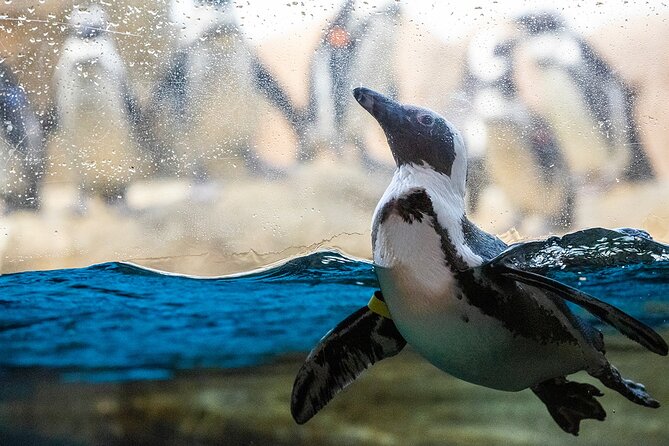
The penguin colony is another must-see. The African penguins are lively and easy to enjoy even if you have no interest in reading every information panel. Try to time your visit around a feeding, when a biologist explains the animals and responds to questions. Two penguins have been known to play at the glass, which can keep children occupied long after the adults are ready to move on.
Morrison Planetarium and the 75-foot dome
The Morrison Planetarium gives you a change of pace from the live-animal areas. Its 75-foot dome screen uses detailed visualizations to present subjects ranging from distant galaxies to the workings of Earth.
The show program changes, and several options and times may be available during the day. Planetarium admission is included, but a seat is not automatic. When you arrive, scan the QR code posted in the lobby to reserve a showtime, or visit the pass pickup desk across from the planetarium entrance.
Make this one of your first tasks. Free passes are first come, first served, and a popular show can fill before you reach that part of the building. The planetarium’s schedule gives you a useful anchor for the rest of the visit, letting you plan the aquarium and rainforest around a fixed time.
The shows may not suit children under seven, and children under four are not permitted. That age rule matters for families, since the planetarium may be the one part of the Academy that requires advance planning. The program Incoming has received especially strong praise, but show content can change.
The dome experience is also worth considering for adults without children. It offers a more focused science presentation than the open exhibit floors, and it gives your legs a break after walking through the aquarium and museum.
A completely different kind of day out in San Francisco:
- Small Group Yosemite and Giant Sequoias Day Trip from San Francisco
★ 5.0 · 3,671 reviews - San Francisco: Golden Gate Bay Cruise
★ 4.7 · 3,644 reviews - San Francisco: Hop-On Hop-Off Sightseeing Tour with 17 Stops
★ 4.5 · 3,600 reviews - Yosemite Highlights & Giant Sequoias Day Tour from San Francisco
★ 4.5 · 3,455 reviews
The Osher Rainforest: prepare for heat and humidity
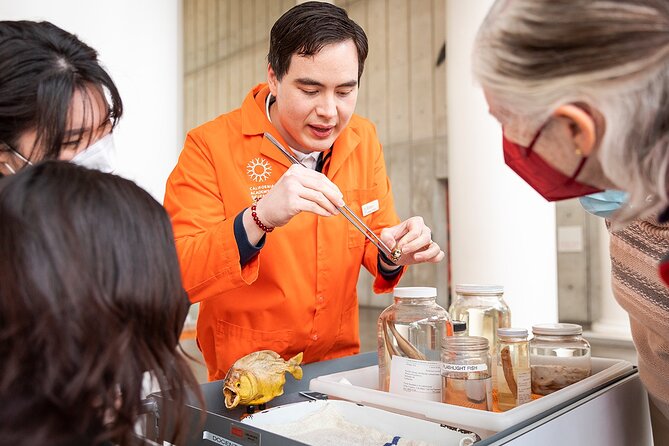
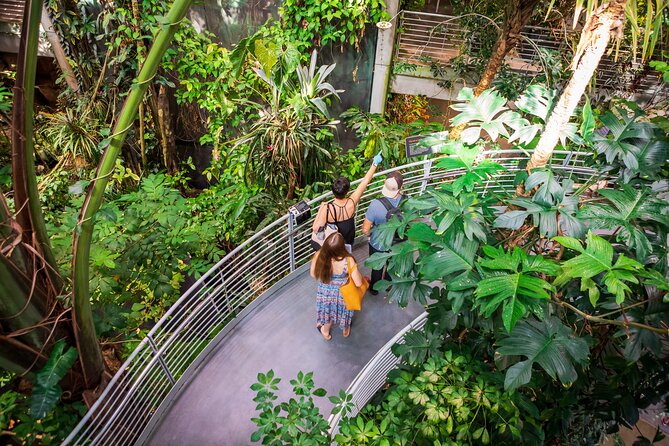
The Osher Rainforest occupies a four-story glass dome. Inside, you will find more than 1,600 plants and animals, including free-flying birds, butterflies, reptiles, golden-silk orb weaver spiders, and large Amazonian fish.
This is one of the Academy’s most memorable spaces because the climate changes as soon as you enter. San Francisco may be cool outside, but the rainforest is warm and humid. Wear comfortable shoes and use layers that you can remove. Glasses may fog, and anyone sensitive to heat should take the exhibit at an easy pace.
Butterflies are a major attraction, especially for children. You might also see birds moving freely overhead or notice spiders that are easy to miss if you rush. The rainforest works best when you slow down and look carefully rather than treating it as a passage between the aquarium and planetarium.
The suggested visit time is around 30 minutes, but you may need longer if the butterflies are active or if you are with young children. The space can feel crowded at busy times, which makes it harder to stop wherever you like. Even so, it is an effective way to show how many forms of life can share one forest system.
Natural history, California, and hands-on exhibits
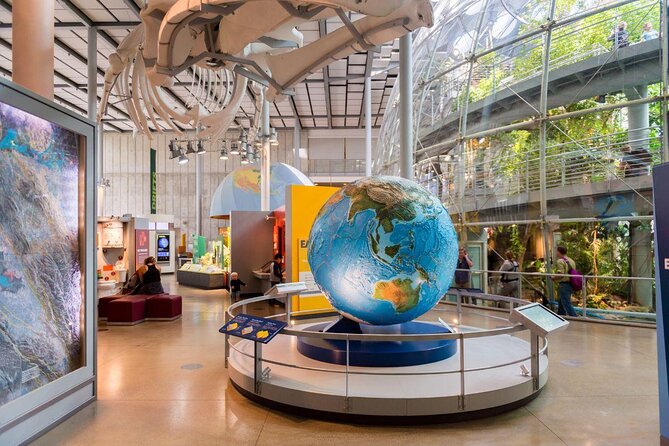
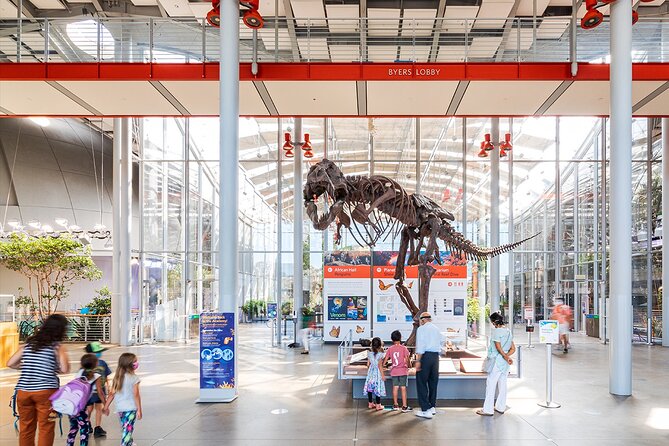
The natural history portion fills out the Academy’s science story. You can walk beneath the bones of some of the planet’s largest animals, inspect geological specimens, and try interactive displays built for active participation.
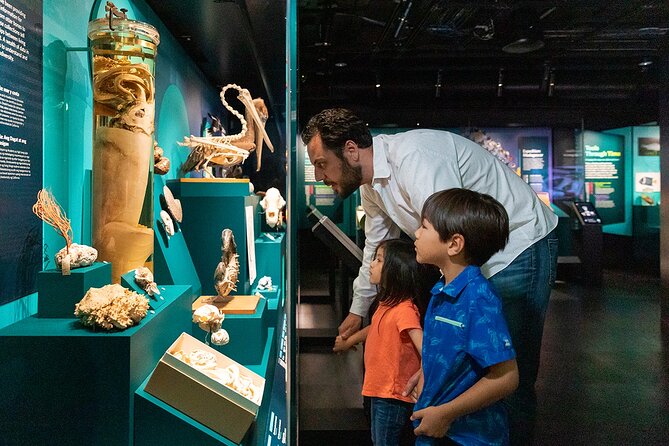
The geology collection includes nearly 400 specimens. That is a good stop for anyone interested in minerals, crystals, and the physical forces that shape Earth. Some visitors may find this section less immediately exciting than the penguins or butterflies, but the displays reward anyone willing to read and look closely.
California: State of Nature connects the state’s species, places, and people across four ecosystems. Its specimens, models, multimedia, and interactive elements explain California’s biodiversity in a local context. This is more useful than a generic nature display because it relates science to the state you are visiting.
The Academy also includes hands-on exhibits such as an earthquake simulator and a dinosaur 3D puzzle. The earthquake feature is a favorite for many families, while the puzzle can turn a display into a shared activity. Staff members may help explain how it works, which is useful when children are trying to assemble the pieces.
Manage expectations around dinosaurs. If your main goal is a large fossil collection, you may find this part less satisfying than the aquarium or rainforest. The Academy is broad rather than devoted to one subject, so its dinosaur material is only one part of a much larger visit.
Public programs make the timing worthwhile
Admission includes daily public programs, animal feedings, pop-up demonstrations, and other scheduled activities. These events give structure to a self-guided visit and add live explanation to the displays.
The penguin feeding is particularly useful because you see the animals behave while a biologist provides context. Pop-up demonstrations can also be a good reason to pause, especially if you have children who learn better by watching something happen than by reading a panel.
Look at the day’s program soon after entering. If you simply wander, you may miss the activity that would have been the highlight. The Academy changes its presentations and exhibits, so the exact schedule is important on the day you visit.
Wander Woods, Hidden Wonders, and the living roof
Wander Woods is an outdoor nature play and exploration space aimed at children. It offers a change from indoor exhibits and gives younger visitors a place to move, experiment, and satisfy their curiosity.
Hidden Wonders presents previously unseen specimens from the Academy’s research collections. This area adds a behind-the-scenes feel to the visit. Instead of seeing only polished public displays, you get a glimpse of the scientific material used for study and discovery.
The living roof is another feature worth noticing. It is part of the Academy’s architectural identity and adds an environmental angle to a building already focused on the natural world. You may also find an observatory or related viewing opportunity that requires a reservation, so ask about access when you arrive if that is important to your family.
The surrounding Golden Gate Park is a real bonus. The Academy sits within one of San Francisco’s best public spaces, so you can combine indoor science with a walk outdoors. You do not need to treat the entire park as part of the ticket, but its setting makes the Academy feel less boxed in than many city museums.
Food, crowds, and the real cost of the day
The admission price is $49 per person. That is not a bargain for a quick visit, but it can be fair value if you stay for three to five hours and use the aquarium, rainforest, planetarium, and museum.
The biggest value question is how much else you spend. Food and drinks are not included, although sustainable grab-and-go items are available at the Academy Café and meals are available at the Terrace Restaurant. Parking has been reported at $31.25, so driving can push the total higher before you even buy lunch.
A family of three could spend roughly $147 on admission alone, then add food and parking. For some families, that is worthwhile because the Academy combines several attractions in one stop. For others, the cost may feel high if the building is crowded or if a favorite section is closed.
Crowds are the main practical drawback. On busy Saturdays, the aquarium, rainforest, and interactive exhibits can be difficult to enjoy at your own pace. Doors, glass panels, tables, and handrails may also need more frequent cleaning during heavy use. Most of the experience can still be excellent, but a crowded day may make the price feel less comfortable.
Comfortable shoes matter. The Academy is large enough for several hours of walking, and the combination of indoor floors, the rainforest, and Golden Gate Park can tire young children. Plan a break rather than trying to force every section into one nonstop circuit.
Who will enjoy this most
Families with children of different ages are the best match. Toddlers can watch penguins and butterflies, school-age children can use the interactive exhibits, and teenagers may prefer the planetarium, aquarium, or earthquake simulator.
Adults without children can also have a very good time. The aquarium, geology collection, rainforest, and planetarium are substantial enough for an adult afternoon, especially if you enjoy natural science and animal behavior.
The Academy is less ideal if you want a quiet, short museum visit or a large dinosaur-focused collection. It can also disappoint if you arrive late and expect to secure a planetarium seat without checking the schedule.
The attraction is accessible to most people, and service animals are allowed. Since this is not a formal guided experience, you can set your own pace and take breaks when needed.
Is the $49 ticket worth booking?
I would book this admission if you want several San Francisco attractions in one stop, particularly if you are visiting with children or you plan to stay most of the day. The penguins, aquarium, rainforest, and planetarium provide enough variety to justify the time, and the mobile entry keeps the arrival simple.
I would be more cautious if you are watching every dollar, driving, or visiting during a crowded weekend. In that case, compare the total cost with other museum or aquarium choices before committing.
Book at least 24 hours ahead if your plans might change, since cancellation is free up to that point. Once inside, reserve the planetarium show immediately, then build the rest of your visit around that time. With that small bit of planning, the California Academy of Sciences becomes one of San Francisco’s most satisfying family-friendly indoor attractions.
FAQ
What does the California Academy of Sciences admission ticket include?
The ticket includes instant-access admission to the California Academy of Sciences. The aquarium, planetarium, rainforest, natural history exhibits, public programs, animal feedings, and pop-up demonstrations are included with admission.
How much does admission cost?
The listed price is $49 per person. Food, drinks, parking, and hotel transportation are not included.
How long should I plan to spend at the Academy?
Plan on approximately three to five hours for a relaxed visit. You can see the main sections in less time, but a planetarium show, public programs, food, and time in the park may extend your visit.
Do I need to reserve a planetarium show?
Yes. Planetarium passes are free but offered on a first-come, first-served basis. Scan the QR code in the lobby when you arrive, or use the pass pickup desk across from the planetarium entrance.
Are young children allowed in the planetarium?
Shows may not be appropriate for children under seven. Children under four are not permitted in the planetarium.
Can I cancel the ticket for a refund?
Yes, if you cancel at least 24 hours before the experience start time, you can receive a full refund. Cancellations or changes made within 24 hours are not accepted and are not refundable.
Recently added around San Francisco
- San Francisco: Golden Gate Bridge Catamaran Cruise★ 4.9 · 499 reviews
- From San Francisco: Guided Muir Woods Excursion★ 4.6 · 504 reviews
- Inside Alcatraz Tour Including Fisherman’s Wharf Lunch Credit★ 4.0 · 505 reviews
- From San Francisco: Napa & Sonoma Valley Full-Day Wine Tour★ 4.5 · 513 reviews
- Muir Woods and Sausalito Tour Plus Bay Cruise★ 4.0 · 514 reviews
- San Francisco: Muir Woods & Sausalito Tour with Ferry Option★ 4.5 · 515 reviews
- San Francisco: Golden Gate Bridge to Sausalito Cycling Tour★ 4.7 · 541 reviews
- San Francisco: Small-Group City Tour by Vintage VW Bus★ 4.9 · 549 reviews
San Francisco Tours, compared.
Muir Woods and Sausalito (Return by Bus or Ferry)
Read our review →
Big Bus SF: Hop-on Hop-off Tour with 17 Stops and Sunset Option
Read our review →
Napa and Sonoma Wine Country Full-Day Tour from San Francisco
Read our review →
Small Group Yosemite and Giant Sequoias Day Trip from San Francisco
Read our review →
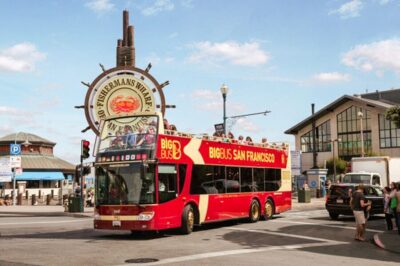
Hop-On Hop-Off Sightseeing Tour with 17 Stops
Read our review →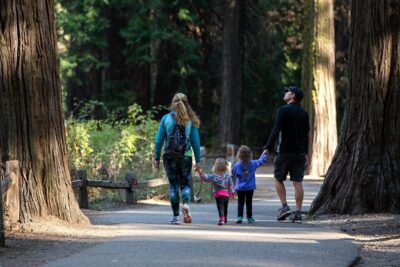
Yosemite Highlights & Giant Sequoias Day Tour from San Francisco
Read our review →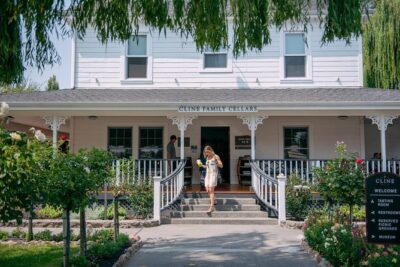
San Francisco Super Saver: Muir Woods & Wine Country w/ optional Gourmet Lunch
Read our review →Browse the lists this tour appears in