

Reviewed · AUSTIN TOURS
Double Decker Austin Single Loop Sightseeing Tour
Austin reveals itself quickly. This 75 to 90-minute double-decker ride links downtown, the Capitol, the University of Texas, South Congress, and Lady Bird Lake in one easy loop. I like the open-air upper deck for city views and photos, and I like having a climate-controlled lower deck when Texas weather turns harsh. The main tradeoff is simple: you see many sights from the bus, but you do not get off to explore them.
I also like that this is a useful first-day activity. Guides such as Jason, Will, and Lawrence have earned praise for friendly local stories, food suggestions, and a good sense of Austin’s layout. Still, the experience depends heavily on the guide, and a few riders found the commentary thin or the jokes distracting. The route also spends meaningful time around the University of Texas, which may please campus fans but frustrate anyone expecting a fuller tour of west downtown.
In This Review
- Key things to know before you board
- Why this bus ride works well on arrival
- Choosing the right seat for Austin weather
- The downtown loop, from 6th Street to the Driskill
- The Texas Capitol and Governor’s Mansion
- UT Austin gives the middle of the tour a different feel
- South of the lake: bats, music, and South Congress
- What the commentary is really worth
- Price, timing, and practical value
- Who should book this Austin loop?
- Should you book the Double Decker Austin tour?
- FAQ
- Where does the Austin double-decker tour begin?
- Where does the tour end?
- How long does the tour last?
- How much does the tour cost?
- Is the tour a single loop?
- Is seating available indoors and outdoors?
- What language is the tour offered in?
- How many people can join the tour?
- Can I cancel for a refund?
Key things to know before you board

- You cover a lot in one loop: The route connects 6th Street, the Driskill Hotel, the Texas Capitol, UT Austin, South Congress, the Congress Avenue Bridge, and the Long Center.
- The upper deck is open air: It offers the best photo angles, but low tree branches can be a nuisance, and weather matters.
- The lower deck is climate controlled: Choose it for shelter from heat, wind, or rain.
- Live commentary shapes the ride: The best guides add history, humor, and practical ideas for the rest of your visit.
- It begins and ends downtown: Meet at 103 E 5th St., by the Austin Visitor Center on Red River Street between 4th and 5th Streets.
- The price is reasonable for orientation: At $36.81 per person, it works best as a time-saving overview, not as a replacement for museum visits or walking tours.
Why this bus ride works well on arrival
Austin is spread across several districts, and its major sights do not all sit within a single compact old town. A loop tour helps you connect the pieces before you decide where to spend your limited time.
You pass from the historic core around 6th Street toward the Capitol and UT campus, then continue south toward Lady Bird Lake, the Congress Avenue Bridge, and South Congress. That broad sweep is the real value. You get a working map of the city instead of seeing only the blocks around your hotel.
I would schedule this early in an Austin visit if your plans allow. The ride can help you choose where to return for dinner, music, museums, shopping, or a walk. Several riders specifically used it to shape the rest of their schedule.
The tour is also a relief for anyone who does not want to walk Austin’s streets in the heat. You can sit, listen, and watch the city pass by. The bus carries a maximum of 35 people, so it is not an enormous sightseeing vehicle, though the feel of the ride can still vary depending on how full it is.
A few more US trips worth a look
- Best of Austin Small-Group Driving Tour with Local Guide
★ 5.0 · 2,275 reviews - Austin Biker Gang E-Bike Tour
★ 5.0 · 1,399 reviews - Austin Food Tour with Local Flavors, Tacos & 6 Food Tastings
★ 5.0 · 987 reviews
Choosing the right seat for Austin weather
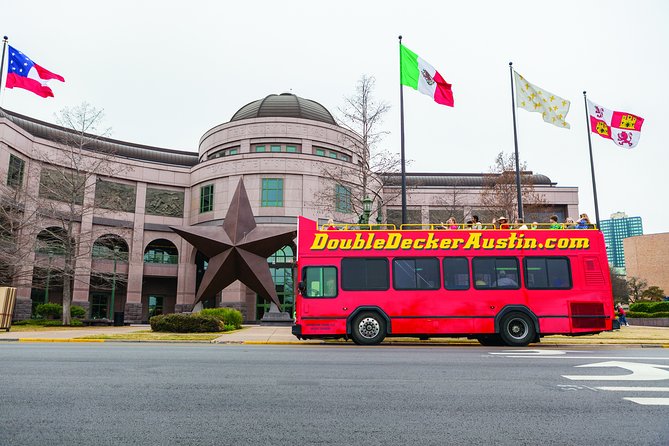
The open top deck is the obvious choice for photographs. You get a higher view over passing buildings, and the breeze can make a warm afternoon much more comfortable. A solo rider who sat at the front described it as feeling almost like a private guide position, an especially good choice if that seat is available.
But the upper deck has drawbacks. Low branches may brush close to the bus, and riders have had to duck around trees. This is worth taking seriously if you are tall or sitting near the outside edge. The upper deck also leaves you exposed to sun, wind, and rain.
The lower deck is climate controlled and gives you a safer bet in uncertain weather. You lose some of the elevated views, but you gain shelter and a more predictable ride. Since the tour requires good weather and can be canceled if conditions are poor, check the forecast before you book.
The best practical approach is to arrive ready to choose. On a mild, clear day, I would aim for the upper deck. On a very hot, wet, or windy day, the lower level makes more sense.
The downtown loop, from 6th Street to the Driskill
The first section introduces Austin’s central districts and older landmarks. Historic 6th Street is the city’s best-known entertainment corridor, lined with music venues and nightlife. From a bus seat, you get orientation rather than a full sense of the street after dark, but it is a useful first look.
The route also passes the Austin Convention Center and the historic Central Fire Station No. 1. The Austin Fire Museum is located inside the old station and displays uniforms, photographs, and firefighting memorabilia from the 19th through 21st centuries. The bus does not turn this into a museum visit, but the mention may give you another stop for later.
The Hannig House adds an important piece of local and Texas history. Built in 1869 for Joseph Hannig and Susanna Dickinson Hannig, the house connects Austin to the Battle of the Alamo. Susanna Dickinson survived the battle and carried news of its fall to Sam Houston, making her story part of the chain of events that led to Texas independence.
You also pass the home associated with William Sydney Porter, better known by his pen name, O. Henry. The site explores his life in Austin and includes an interior visit. Again, treat this as a signpost for a later stop, not as time to tour the house from the bus.
The Driskill Hotel is one of the most memorable buildings along this part of the loop. Completed in 1886 in Romanesque style, it is the oldest operating hotel in Austin. Colonel Jesse Driskill, a cattleman, built it as what he hoped would be the finest hotel south of St. Louis. Its ornate exterior gives the ride a strong architectural moment amid the city’s newer buildings.
The Texas Capitol and Governor’s Mansion
The Texas State Capitol is one of the major reasons to take this route. It is widely regarded as one of the country’s notable state capitol buildings and has both National Register of Historic Places and National Historic Landmark status.
You pass rather than tour the Capitol, so the bus is best for first impressions and orientation. One useful caution comes from riders who wished the vehicle had slowed down more near the Capitol and nearby courthouse. If you want detailed architecture or interior access, plan a separate visit.
The Texas Governor’s Mansion is another important stop along the route. Built in 1856, it has served as the official residence of Texas governors and their families for generations. It is the fourth-oldest continuously occupied governor’s residence in the United States and the oldest west of the Mississippi River.
The house was severely damaged by arson in 2008 while empty, with its contents in storage. Its restoration is part of the story, and the building continues to serve its original public role. From the bus, you get context and a view of the exterior, not a full house tour.
The Austin Visitor Center, where you start and finish, is handy after the ride. It includes exhibits, tours, a gift shop, and a travel center. You can grab a souvenir or gather more ideas before setting off on foot.
A completely different kind of day out in USA:
- NYC: SUMMIT One Vanderbilt Tickets
★ 4.7 · 51,195 reviews - NYC: 9/11 Memorial & Museum Timed-Entry Ticket
★ 4.8 · 31,428 reviews - NYC: Empire State Building Tickets – Observatory & Museum
★ 4.7 · 25,757 reviews - NYC: Empire State Building Observation Deck Tickets
★ 4.7 · 22,072 reviews
UT Austin gives the middle of the tour a different feel
The route then shifts toward the University of Texas at Austin. This is where opinions are most divided. The campus includes several major sights, and the bus spends a noticeable portion of the tour here. If you like college architecture, Texas football, or presidential history, this section is worthwhile. If your priority is downtown neighborhoods, it may feel too long.
Darrell K Royal Texas Memorial Stadium has been home to the Longhorns football team since 1924. Its size helps explain the cultural importance of college football in Texas. The 307-foot UT Tower, completed in 1937, is the university’s most recognizable landmark and a strong visual marker from the bus.
The route also passes the Lyndon Baines Johnson Library and Museum. Its exhibits cover the presidency and the public life of Lyndon Johnson. The ride gives you a reason to return, but you will need a separate visit to see the collections properly.
Nearby, the Bullock Texas State History Museum presents the story of Texas through exhibits and educational programs. The Blanton Museum of Art holds more than 19,000 works, ranging from ancient Greek pottery to abstract expressionism. The Harry Ransom Center focuses on literature, photography, film, art, and the performing arts through its research collections.
These places make UT more than a campus drive. They offer some of Austin’s strongest indoor stops. The limitation is time. The bus can point them out, but it cannot give you enough time to understand any one museum.
South of the lake: bats, music, and South Congress
After the university area, the tour heads toward Lady Bird Lake and the Congress Avenue Bridge. The bridge shelters North America’s largest urban bat colony, with an estimated 750,000 to 1.5 million bats emerging near dusk between April and October.
Timing matters here. A daytime loop can tell you about the bats, but it will not deliver the full evening spectacle. If seeing the colony is a priority, return to the bridge around dusk during the best viewing months. The bus ride helps you understand where to go.
South Congress, often called SoCo, is one of the most appealing areas to revisit on foot. This district south of Lady Bird Lake combines boutiques, eateries, galleries, and music venues with older Austin character. The bus gives you a quick visual introduction, but this is one place where I would return slowly and explore at street level.
The Long Center closes out the route with a look at Austin’s performing arts scene. It hosts performances, music, films, festivals, and community events. Its location near the lake makes it a useful landmark for understanding the connection between downtown and the southern side of the city.
The route also includes Lady Bird Lake’s hike and bike trail, Auditorium Shores, Austin City Hall, the Moody Theater, the Warehouse District, Waterloo Park, the Paramount Theater, Moonlight Towers, Santa Rita No. 1, the Bremond Block, and the Heman Marion Sweatt Travis County Courthouse. You see these as part of a moving city overview, not as individual stops with time to get off.
What the commentary is really worth

The guide can make or break a city loop. The strongest accounts describe guides who are warm, upbeat, and full of useful background. Jason received praise for local suggestions about food and entertainment. Will was described as an entertaining guide with strong knowledge of Austin and Texas history. Lawrence was singled out for being welcoming and well prepared.
One guide, an Austin transplant from the United Kingdom, received particularly positive marks for explaining local culture clearly. That is a helpful reminder that being born in Austin is not the only measure of a good guide. The key is whether the person can connect buildings, events, and neighborhoods in a way you can use.
The weaker experiences had a different pattern. Some riders felt the guide spoke too quickly, offered too few details, or left notable buildings unexplained. One person disliked the joking style and felt the university section took too much time. Another wished the tour had included more African American history, including the Barbara Jordan Building.
That range matters because live narration is not standardized in the way an audio recording would be. I would book this for a broad, friendly introduction, not for a specialist history lesson. If you want detailed coverage of every building or a carefully balanced account of Austin’s many communities, keep your expectations in check and plan additional visits.
Price, timing, and practical value
At $36.81 per person, the tour is fairly priced for a ride lasting about 1 hour and 15 minutes to 1 hour and 30 minutes. You are paying for transportation, a guide, an upper deck, a sheltered lower deck, and a route that links several areas you might otherwise struggle to connect quickly.
The value improves if you are in Austin for a short stay, traveling with family, or avoiding a long hot walk. It also makes sense if you want to learn where the museums, nightlife districts, lakefront, and campus sit relative to one another.
The value drops if you expect hop-on, hop-off freedom or detailed visits at each attraction. This is a single loop that returns to the starting point. It is an overview, not a pass for entering the Capitol, museums, Governor’s Mansion, or historic homes.
The meeting point is at 103 E 5th St. in downtown Austin, at the Austin Visitor Center on Red River Street between 4th and 5th Streets. Arrive about 15 minutes before departure for boarding. The activity ends back at the same meeting point, which makes it easy to continue downtown afterward.
A mobile ticket is provided, and the tour is offered in English. Service animals are allowed, the meeting point is near public transportation, and most people can participate. Free cancellation is available up to 24 hours before the start time. Inside that window, changes and refunds are not accepted. If poor weather or an insufficient number of bookings cancels the tour, you can choose another date or receive a full refund.
Who should book this Austin loop?
I would recommend it to first-time Austin visitors who want a quick map of the city. It is also a good fit for families, older visitors, solo riders, and anyone who wants a break from walking. The easy format lets you see a lot without arranging several separate stops.
It suits people who enjoy a guide’s personality and appreciate small facts along the way. The most praised rides combine history with practical suggestions for food and evening plans, making the experience useful beyond the 90 minutes on the bus.
I would be cautious if you want deep coverage of African American history, detailed architecture, or a route focused only on downtown. I would also reconsider on a very hot or stormy day unless you are comfortable using the lower deck. If the University of Texas is not of interest, ask yourself if a long campus segment will bother you.
Should you book the Double Decker Austin tour?
Book it if you want an efficient first look at Austin and understand that the sights are viewed from the bus. The Texas Capitol, Driskill Hotel, UT Tower, Congress Avenue Bridge, South Congress, and lakefront make a strong route, and the upper deck adds a pleasant sightseeing angle.
Skip it if you want to get inside attractions, walk neighborhoods in depth, or control every minute of your day. For most first visits, though, the $36.81 price buys useful orientation, comfortable sightseeing, and a practical list of places to explore later. I would take it near the beginning of an Austin stay, then return to the spots that catch your eye.
FAQ
Where does the Austin double-decker tour begin?
It begins at 103 E 5th St., Austin, Texas 78701, at the Austin Visitor Center on Red River Street between 4th Street and 5th Street.
Where does the tour end?
The activity ends back at the original meeting point.
How long does the tour last?
The tour lasts approximately 1 hour and 15 minutes to 1 hour and 30 minutes.
How much does the tour cost?
The listed price is $36.81 per person.
Is the tour a single loop?
Yes. It follows one sightseeing loop around Austin and returns to the starting point.
Is seating available indoors and outdoors?
Yes. You can sit on the open-air upper deck or in the climate-controlled lower deck.
What language is the tour offered in?
The tour is offered in English.
How many people can join the tour?
The maximum group size is 35 people.
Can I cancel for a refund?
You can cancel up to 24 hours before the start time for a full refund. Cancellations or changes made less than 24 hours before the experience are not accepted for a refund.
Recently added around USA
- Philadelphia: Revolution and The Founders History Tour★ 4.6 · 450 reviews
- South Maui: Molokini Snorkeling Adventure★ 4.6 · 450 reviews
- DC Monuments & History Guided E-Cart Tour-Blankets★ 4.5 · 450 reviews
- From Manhattan: 5-Hour Bronx, Queens, and Brooklyn Bus Tour★ 4.7 · 451 reviews
- PRIVATE Sedona Jeep Tour 2-hour Lil’ Rattler Off-Road★ 5.0 · 450 reviews
- All-Inclusive Sandbar Safari with Dolphin Playground Encounter★ 4.5 · 451 reviews
- Hoover Dam Inside Tour from Las Vegas, WiFi★ 4.5 · 451 reviews
- Private Guided New York City Tour by SUV★ 5.0 · 451 reviews
Austin Tours, compared.

Best of Austin Small-Group Driving Tour with Local Guide
Read our review →

Austin Food Tour with Local Flavors, Tacos & 6 Food Tastings
Read our review →




Austin in a Nutshell Bike Tour with a Local Guide
Read our review →Browse the lists this tour appears in