
Reviewed · WORKSHOPS
Maui: Two Hour Beginner Group Surf Lesson in Kihei
Your first wave may come sooner than expected. This two-hour Kihei lesson gives beginners a friendly introduction to surfing, with no more than six students, an instructor, board, rash guard, and water booties included. I especially like the small class size and the promise that your next lesson is free if you do not get surfing in the first one. The main catch is simple: ocean conditions are never guaranteed, and a few students found the waves too small on their lesson day.
The meeting point is Surf Shack at 1976 South Kihei Road. You will handle your own transport, but the location is convenient, with parking, shops, food trucks, and family-friendly beaches nearby. The instructors receive especially high praise for patience and encouragement, with names such as Mike, Ivan, Jay, Sofia, Francisco, Justo, and Sofi appearing often in the feedback. One practical note: the water booties are described as thin, so you may prefer to bring sturdier ones if you already own a pair.
In This Review
- Key points at a glance
- Why this Kihei lesson works for first-time surfers
- What happens during the two hours
- Beach instruction and preparation
- Moving into the water
- Repeating the basic ride
- The Kihei setting and what to do nearby
- Equipment, comfort, and the photographer
- How much value do you get for $98?
- Who should book this lesson?
- When to book and how to prepare
- The main strengths and limitations
- Should you book the Kihei surf lesson?
- FAQ
- Where does the surf lesson begin?
- How long is the beginner surf lesson?
- How many people are in each group?
- What is included in the price?
- Is hotel pickup included?
- What is the minimum age?
- What happens if I do not surf during the first lesson?
Key points at a glance
- Small groups of six or fewer: You get more attention than in a large beach class, with instructors able to help position your board and time your start.
- Built for first-timers: The lesson covers ocean awareness, safety, wave riding, rules, and etiquette before you head into the water.
- A real first-wave guarantee: If you do not get surfing in the first lesson, your next lesson is free.
- Kihei location with nearby diversions: People waiting on the beach can find shops, food trucks, and family-friendly shoreline close to the meeting point.
- Photography is available for an extra fee: The in-water photographer may capture attempts and posed shots, but photos are not part of the $98 price.
- Best for ages nine and up in a group: Children ages five to nine should arrange a private lesson for safety and closer instruction.
Why this Kihei lesson works for first-time surfers
Surfing can look simple from the beach. Paddle, pop up, ride. In practice, the timing, balance, and wave judgment can make your first attempt feel like a small puzzle. This lesson breaks that puzzle into manageable parts.
You begin with the basics: how to lie on the board, where to place your hands, how to push up, and how to get your feet underneath you. You also learn the rules that keep a beginner session orderly. Ocean awareness, water safety, wave selection, and surf etiquette matter just as much as standing up.
That early instruction is useful because beginners often focus only on the thrill of catching a wave. A good lesson also teaches you how to avoid getting in another surfer’s way, how to behave around the board, and what to do when you fall. The teaching is aimed at people who have never surfed, so you do not need previous experience.
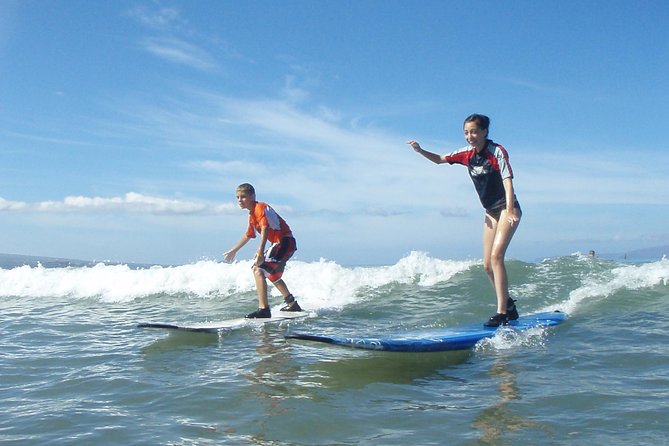
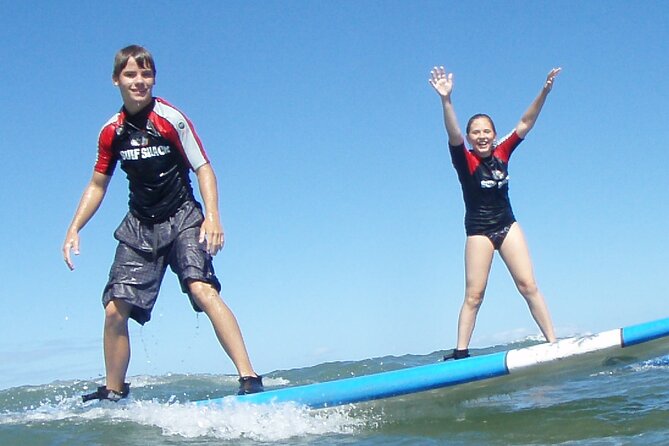
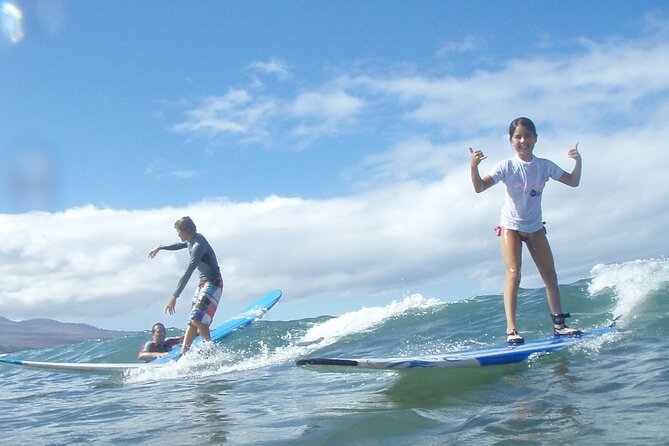
The strongest part of the format is the six-person limit. Even six students can create some waiting time, but it is far more manageable than a large class. Instructors can watch each attempt, offer corrections, and help push or guide the board when the timing is right. Several people describe getting up on multiple waves, and some say everyone in their group managed to stand.
The first-wave guarantee adds useful reassurance. It does not control the ocean, and it does not promise a perfect ride for every person. It does show that the company expects its beginner method to produce a genuine surfing attempt. If you do not get surfing during your first lesson, you can take another lesson free, subject to the provider’s terms.
A few more US trips worth a look
- Outrageous Surf ScHool Lesson on Lahaina Side
★ 4.5 · 547 reviews - New Orleans Demonstration Cooking Class with Meal
★ 5.0 · 3,000 reviews - Instructor-Led Line Dancing Class with Souvenir Video
★ 5.0 · 1,394 reviews
What happens during the two hours
The exact split between beach time and water time can vary. One account describes a short beach tutorial followed by about an hour and a half in the water. That gives you a realistic idea of the rhythm: learn the movement on land, then spend most of the session practicing it.
Beach instruction and preparation
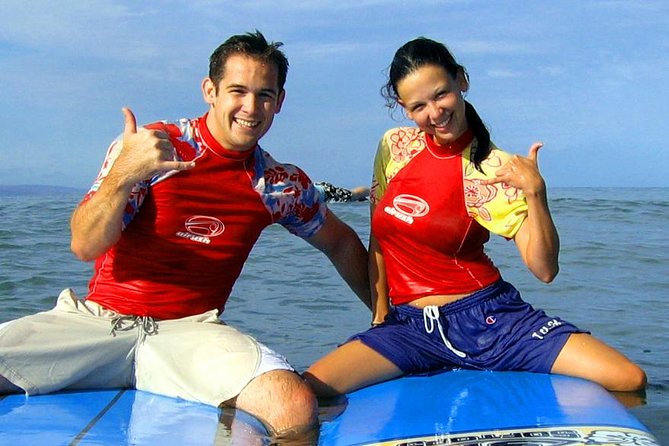
At Surf Shack, you receive your surfboard, rash guard, and water booties as part of the lesson. The rash guard helps protect your skin from the board, while the booties give your feet some protection as you move around in the shallows.
The instructor then demonstrates the basic movement on land. Pay close attention here. The beach practice is short, but it gives you a chance to understand the pop-up before you have to manage a board, a wave, and your balance at once.
This is also where the safety and etiquette discussion matters. You learn how to handle the board, where to look, and how to share the water. The lesson is not just a quick attempt to get you upright for a photograph. The stated teaching includes ocean awareness and basic surfing rules, giving you a better base for future practice.
Moving into the water
Once the class is ready, you walk out with the instructor and start working on small waves. The water is described as shallow when you fall off, which can make the first attempts feel less intimidating. Still, you should expect a physical session.
Paddling, lifting your upper body, and repeatedly getting into position use your arms and core. One person specifically described it as an arm workout. Build in a little rest between attempts, especially if you are not used to swimming or board sports.
The instructor helps you choose the right moment. In some accounts, the teacher pushes the board at the start so you can concentrate on the pop-up and balance. That is an important beginner aid. You are not left to figure out every part at once.
When the conditions cooperate, the payoff comes quickly. You may get your first ride on an early attempt, then spend the rest of the lesson improving your timing. Even if you only ride small waves, standing up and gliding toward shore is a genuine thrill.
A completely different kind of day out in Maui:
- Maui Pineapple Farm Tour in Haliimaile
★ 5.0 · 2,855 reviews - Maui Eco-Raft Tour: Eye-Level Whale or Dolphin Watching – Lahaina
★ 5.0 · 2,482 reviews - Maui Snorkeling Adventure to Molokini and Turtle Town
★ 4.5 · 2,221 reviews - Maui: Haleakala Sunrise Spectacular with Local Breakfast
★ 4.5 · 2,155 reviews
Repeating the basic ride
Expect repetition. You will lie on the board, wait, paddle, push up, lose balance or ride briefly, then reset. That is the normal pattern for a first lesson.
The instructors appear to keep the mood relaxed rather than turning the class into a test. Mike is repeatedly praised for being encouraging and fun, while Ivan, Jay, Sofia, Francisco, Justo, and Sofi also receive warm comments for patience and clear instruction. The names matter because a beginner lesson depends heavily on the person beside you in the water.
You should not expect advanced technique in two hours. This is a first taste, not a full surf-training course. The goal is to understand the basic movement, catch a few waves, and leave with enough confidence to decide if you want to continue.
The Kihei setting and what to do nearby
The class meets in Kihei, a practical base for a beginner surf lesson. The lesson area can get crowded, according to one detailed account, but the same person found it suitable for first-timers. That is a fair tradeoff. A crowded beginner beach may feel less private, but you are also surrounded by people learning at a similar level.
The nearby area helps if your group is split between surfers and spectators. Family-friendly beaches are a short walk away, and shops and a food-truck area are across the street. That means someone waiting for a lesson can stay occupied without arranging a separate outing.
Parking is described as convenient, though you should still allow enough time to arrive, find the shop, and get ready. Hotel pickup and drop-off are not included. You need to reach Surf Shack at 1976 South Kihei Road and return there after the session.
The setting is also useful for planning the rest of your day. A morning lesson leaves time for another Maui activity, while nearby food options make it easy to eat afterward. Surfing can leave you tired, so keeping your schedule flexible is sensible.
Equipment, comfort, and the photographer
The $98 price includes the main items you need for the lesson: a surfboard, rash guard, water booties, professional instruction, taxes, and the $1 state ocean stewardship fee. That makes the price easier to judge because you are not separately renting the board or paying an extra beach access charge.
You should bring the personal items that are not listed as included, such as anything you need before and after getting wet. Hotel transport is not provided. The supplied booties are functional, but one person found them quite thin and suggested bringing your own sturdier pair if you have them. That is a comfort tip, not a requirement.
A photographer may work in the water during the class. This can be a nice extra because your first surf lesson is difficult to document from shore. The photographer may capture your attempts, successful rides, and posed shots.
Photography costs extra. One reported option was $40 for a single photograph or $75 for the full collection, with about 20 images in that particular case. Those prices and the number of photographs may change, so treat them as a guide rather than a promise. If you want proof of your first wave, budget separately. If not, simply enjoy the session without feeling you need to buy anything.
How much value do you get for $98?
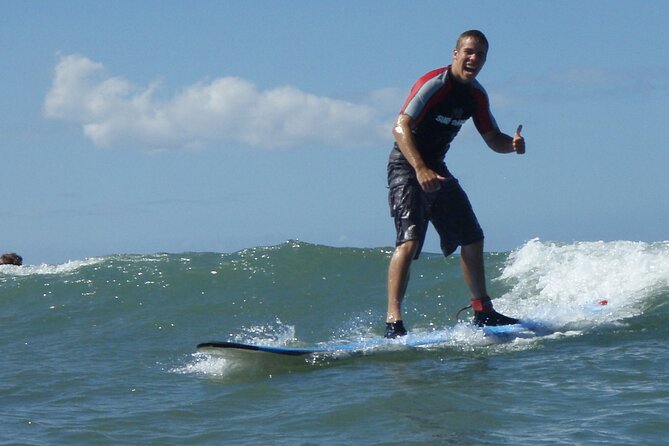
At $98 per person, this is not the cheapest way to spend two hours in the ocean. You are paying for instruction, equipment, a small class, safety guidance, and the convenience of a structured first attempt.
The six-person maximum is the key value point. A cheaper class with a much larger group could leave you waiting while an instructor helps someone else. Here, the stated limit gives you a better chance of receiving direct help with your board and pop-up.
The first-wave guarantee also reduces some of the risk. You are not promised ideal waves, and the guarantee does not change the weather. But if the lesson does not get you surfing, the free follow-up lesson gives you another opportunity rather than ending the experience after one unsuccessful session.
The price is strongest for families, couples, and friends who want a shared activity. It is also appealing if you have always wanted to try surfing but do not plan to buy or rent equipment on your own. Several people describe the lesson as a highlight of their Maui visit, and one parent said teenagers left with enough skill to continue surfing independently.
I would think twice if your only goal is a long, quiet session with no waiting. Even a small class has several students, and the ocean may produce slow conditions. One account notes that the waves were almost nonexistent on the day of the lesson. Another says calm water meant fewer waves but also more time to rest. That is the honest tradeoff: the instructor can teach well, but cannot order the Pacific to send better sets.
Who should book this lesson?
This lesson fits adults and children who are physically ready for a first surfing attempt and comfortable spending time in the ocean. It works particularly well for families because the class is friendly to mixed ages, and several children managed to stand and catch waves.
The formal minimum age for the group lesson is nine. The information also says children ages five to nine should book a private lesson for safety and a better fit. Because those age notes overlap at age nine, confirm the correct booking option if your child is exactly nine.
You do not need to be an athlete, but you should expect paddling, repeated attempts, and falls into shallow water. One person in their sixties successfully tried surfing after wanting to do it for decades. That is encouraging, though your comfort level and fitness still matter.
This is also a good choice for a solo participant. You can join the small group, meet other beginners, and receive instruction without needing to organize a full party. The class is offered in English.
When to book and how to prepare
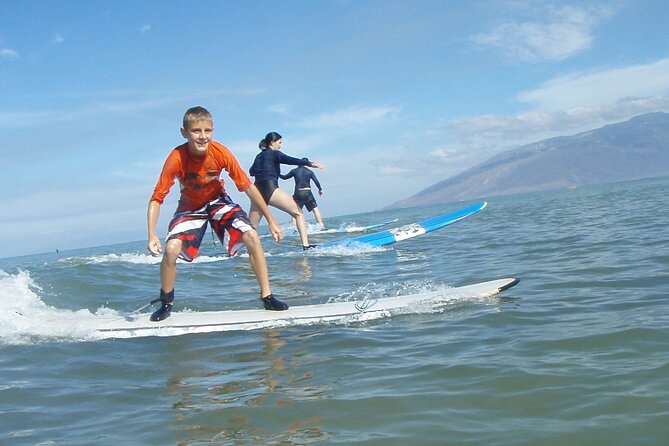
The experience is booked about 21 days ahead on average, so do not leave it until the final day of your Maui stay. Booking earlier gives you more room to move the lesson if weather, health, or scheduling gets in the way.
The cancellation terms are friendly if you plan carefully. You can cancel up to 24 hours before the local start time for a full refund. Inside that 24-hour window, the payment is not refunded, and changes are not accepted.
Before booking, check your group’s ages and decide if the small-group format suits everyone. Children below the group minimum need a private lesson. Also remember that you must arrange your own way to Kihei.
On the day, allow time for the short beach instruction and the physical work that follows. Wear what you are comfortable getting wet in, use the provided rash guard and booties, and consider bringing sturdier water footwear if thin soles bother you. If you are interested in photographs, ask about current prices before deciding.
The main strengths and limitations
The highest praise goes to the instructors. That is important because surfing instruction can quickly become frustrating if corrections are unclear or the teacher seems rushed. Mike is singled out again and again for his energy and encouragement, while Ivan, Jay, Sofia, Francisco, Justo, and Sofi are also praised for helping beginners feel safe and capable.
The second major strength is the success rate described by people who took the class. Beginners of different ages report standing up, catching several waves, or getting surfing by the second attempt. The lesson design clearly aims for an early win.
The limitations are modest but real. Kihei can be crowded, the group is small rather than private, and wave quality depends on nature. Photography costs extra, the company does not provide hotel transport, and the thin booties may not suit everyone.
The overall rating is 4.9 from 950 ratings, with 97 percent recommending the activity. Those numbers point to a consistently well-liked beginner program, but they should not make you expect identical conditions every day. Your result will depend on the instructor, your comfort in the water, and the waves available that morning.
Should you book the Kihei surf lesson?
I would book this if you want a well-organized first try at surfing without renting gear or learning alone. The six-person cap, friendly instructors, included equipment, and free follow-up promise make $98 a reasonable price for a two-hour introduction.
Choose it especially if you are traveling with children age nine or older, teenagers, or friends who want a shared Maui memory. If you need a private setting, have a child under the group minimum, or cannot accept the chance of small waves, choose a private lesson or another date.
For most first-timers, this is a sensible way to meet the ocean on its own terms. You may wobble, fall, laugh, paddle hard, and eventually rise into a short ride. That first little glide is what you are paying for.
FAQ
Where does the surf lesson begin?
The lesson begins at Surf Shack, 1976 South Kihei Road, Kihei, Hawaii 96753. The activity ends back at the same meeting point.
How long is the beginner surf lesson?
The lesson lasts approximately two hours. One account described a short beach tutorial followed by about one and a half hours in the water.
How many people are in each group?
The group has a maximum of six students. Smaller groups give you more opportunity for individual help during the lesson.
What is included in the price?
The $98 price includes the surfboard, rash guard, water booties, professional instruction, taxes, and the $1 state ocean stewardship fee.
Is hotel pickup included?
No. Hotel pickup and drop-off are not included, so you must arrange your own transport to and from Surf Shack.
What is the minimum age?
The group lesson has a minimum age of nine. Children ages five to nine should book a private lesson for safety and closer instruction.
What happens if I do not surf during the first lesson?
The company guarantees that you will get surfing in one easy lesson. If you do not, your next lesson is free, subject to the provider’s terms.
Recently added around Maui
- South Maui: Molokini Snorkeling Adventure★ 4.6 · 450 reviews
- Maui 8 line Zipline Adventure: Soar above valleys & Island views★ 5.0 · 458 reviews
- Rappel Maui Waterfalls and Rainforest Cliffs★ 5.0 · 459 reviews
- Maui: Eco-Friendly Molokini & Turtle Town Tour with Meals★ 4.5 · 464 reviews
- Maui: Molokini and Turtles Luxury Yacht Snorkel★ 5.0 · 477 reviews
- Doors Off West Maui and Molokai 45 minute Helicopter Tour★ 5.0 · 487 reviews
- Best Haleakala Downhill Self-Guided Bike Tour with Maui Sunriders★ 5.0 · 496 reviews
- Maui Premium Sunset Dinner Cruise & Whale Watch★ 4.5 · 504 reviews
Workshops, compared.

New Orleans Demonstration Cooking Class with Meal
Read our review →
Instructor-Led Line Dancing Class with Souvenir Video
Read our review →
New Orleans Hands-On Cooking Class with Meal
Read our review →
Undiscovered Charleston: Half Day Food, Wine & History Tour with Cooking Class
Read our review →



Browse the lists this tour appears in