
Reviewed · HISTORICAL TOURS
2.5 Hour Philadelphia History Tour with Washington War Tent Show
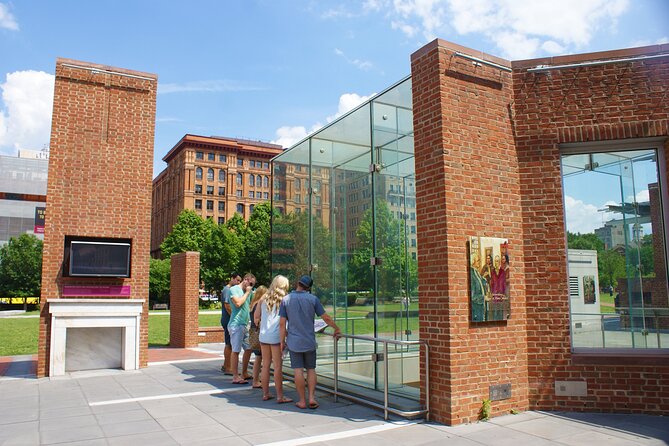
Philadelphia makes American history feel unusually close. This small-group walking tour links the city’s best-known Revolutionary sites in one compact route, from Independence Hall and the Liberty Bell to Elfreth’s Alley and Benjamin Franklin’s grave.
I especially like the presentation of George Washington’s War Tent at the Museum of the American Revolution, along with the discounted museum ticket you can use afterward. I also like the group limit of 12, which gives guides room to answer questions and adjust the conversation. The main drawback is that several famous buildings are viewed from outside, and you do not enter the Liberty Bell Center during the tour.
The experience costs $45 per person and lasts about two and a half hours. Its 4.9 rating from 924 reviews, with 97 percent of customers recommending it, reflects the strongest part of the tour: guides who bring facts, anecdotes, and the city’s complicated past to life. Guides praised by name include Tom, John, Maria Gorshin, Caroline, PJ, Carla, David, Pat, and others.
In This Review
- Key points to know before booking
- Starting at the Signer in Philadelphia’s historic core
- Independence National Historical Park and the buildings of government
- The Liberty Bell, myths and movements
- Carpenters’ Hall and the first Continental Congress
- Washington’s War Tent at the Museum of the American Revolution
- Elfreth’s Alley and Philadelphia’s surviving residential past
- Betsy Ross House and the stories behind national symbols
- Franklin’s grave and the President’s House site
- What the guides do especially well
- Walking pace, timing, and practical limits
- Is $45 a fair price?
- Who should book this Philadelphia walking tour?
- Should you book it?
- FAQ
- How long does the Philadelphia history tour last?
- How much does the tour cost?
- Where does the tour begin?
- Where does the tour end?
- Is admission to Independence Hall included?
- Do you enter the Liberty Bell Center?
- Is the Museum of the American Revolution included?
- How many people can join the tour?
- What is the cancellation policy?
Key points to know before booking
- Washington’s War Tent is the tour’s special draw: You see a presentation featuring the tent George Washington used for much of the Revolutionary War.
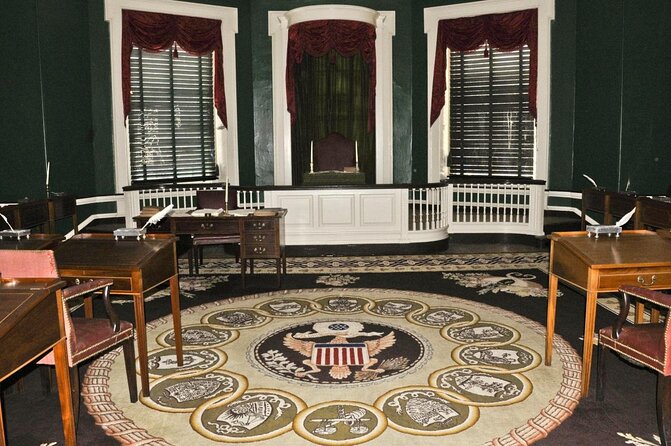
- The route covers the essential Old City sights: Independence Hall, Congress Hall, the Liberty Bell area, Carpenters’ Hall, Elfreth’s Alley, Betsy Ross House, Franklin’s grave, and the President’s House.
- The group is capped at 12 people: That is small enough for questions and personal attention without the cost of a private tour.
- Several landmarks are exterior stops: Independence Hall, Congress Hall, Old City Hall, Carpenters’ Hall, and the Liberty Bell Center are discussed from outside.
- The museum ticket adds value after the walk: You receive a discounted admission option for the rest of the Museum of the American Revolution at a time of your choice after the tour.
- Plan for steady walking: The route connects many sites across Old City, and good weather will make a real difference.
Starting at the Signer in Philadelphia’s historic core
The tour begins at the Signer’s Garden, at 434 to 498 Chestnut Street. The statue represents all the men who signed the Declaration of Independence and the Constitution, rather than honoring one person alone.
This is a fitting starting point. It introduces the big ideas behind the tour, freedom, self-government, and the arguments that shaped the new nation. The stop lasts only about five minutes, but it gives your guide a natural way to explain what you are about to see.
The meeting point is central to Philadelphia’s Historic District and Old City. It is near public transportation, and the tour ends in Old City, so you finish in an area where you can continue sightseeing, eat, or return to a favorite landmark.
More history and heritage tours:
- Revolution and the Founders: History Tour of Philadelphia
★ 5.0 · 2,944 reviews - Philadelphia Old City Historic Walking Tour with 10+ Top Sites
★ 5.0 · 2,020 reviews - Philadelphia: Revolution and The Founders History Tour
★ 4.6 · 450 reviews
Independence National Historical Park and the buildings of government
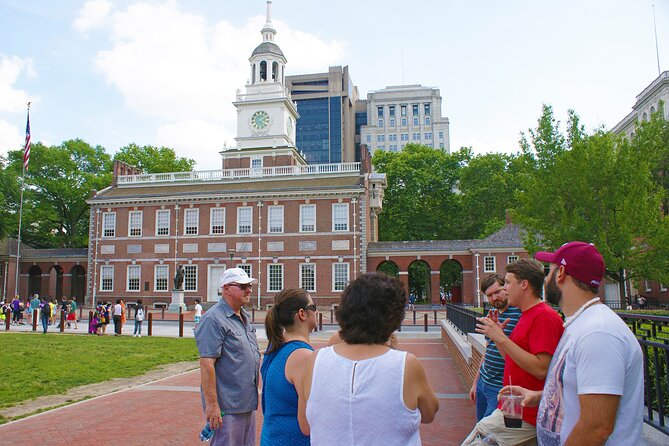
The next section moves through Independence National Historical Park, where Philadelphia’s most famous buildings sit close together. In about 20 minutes, your guide ties together Independence Hall, Congress Hall, and Old City Hall.
That setting matters. You are not seeing isolated monuments with unrelated stories. The buildings formed part of a working civic district where debates about government, law, and national identity took place.
The tour then gives Independence Hall its own 10-minute stop. You circle the building from outside while hearing about the political ideas, arguments, and victories connected with the Founding Fathers. The building appears on the $100 bill, but its real importance is not the familiar image. It is the place where the Declaration of Independence was debated and where the Constitutional Convention met.
You should understand the limitation here. This walking tour does not include an interior visit to Independence Hall. If going inside is a major goal, you will need to arrange that separately. The tour is better at providing a clear overview and context than at replacing a full building visit.
Congress Hall follows with another 10-minute stop. This was the first home of the United States Congress and sits beside Independence Hall. Your guide can show how the early government operated in a city that was still trying to decide what a national capital should look like.
Old City Hall adds another short stop and more discussion of the early republic. Taken together, these three buildings help you follow the shift from colonial protest to organized national government.
The Liberty Bell, myths and movements
The Liberty Bell Center is a 10-minute stop, but the bell itself is not the only subject. Your guide explains how the bell’s meaning changed over time and corrects some of the popular stories attached to it.
The bell later became a powerful symbol for abolitionists, women seeking the vote, and the civil rights movement. That broader story is one of the tour’s strengths. You learn not only about the bell’s colonial setting, but also about how later Americans used the image of liberty to press for rights that the founding generation had denied to many people.
You view the Liberty Bell area from outside during this experience. One review specifically points out that you do not enter the Liberty Bell venue or receive the standard interior photo opportunity. If that picture matters to you, plan to visit the center before or after the walking tour.
This is a good example of the tour’s overall approach. It gives you the historical framework and points you toward places worth exploring later. It is not designed to provide a full indoor visit at every landmark.
Carpenters’ Hall and the first Continental Congress
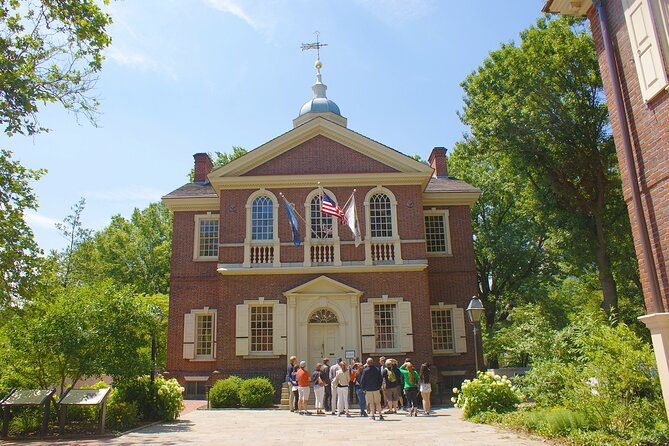
Carpenters’ Hall receives about 10 minutes. The building is associated with Pennsylvania’s early civic life and hosted the First Continental Congress.
The guide discusses its role while you admire the exterior. That setting helps connect the growing resistance to British rule with the practical work of organizing the colonies. The stop is short, so expect a focused explanation rather than an extended visit.
I would pay close attention here if you want the political story to make sense. Independence did not appear in one dramatic moment. Meetings such as the one held at Carpenters’ Hall show the slow process of deciding how the colonies might act together.
A few more US trips worth a look
- From Miami: Everglades Airboat, Wildlife Show & Bus Transfer
★ 4.2 · 8,622 reviews - Miami: Everglades National Park Airboat Tour & Wildlife Show
★ 4.5 · 7,296 reviews - The Haygoods: Branson’s Most Popular Show
★ 5.0 · 7,232 reviews - Oahu: The Magical Mystery Show! at Hilton Waikiki Beach Hotel
★ 5.0 · 2,754 reviews
Washington’s War Tent at the Museum of the American Revolution
The Museum of the American Revolution is the tour’s only major indoor stop. The group spends about 20 minutes inside for a presentation featuring George Washington’s War Tent.
This is the experience’s most distinctive feature. The tent accompanied Washington during many important moments of the Revolutionary War and served as his living and working shelter for much of the conflict. Seeing it presented in a museum setting gives the military story a more personal scale. Washington was not always portrayed as a marble figure or distant commander. He spent long stretches directing an uncertain war from a field headquarters.
The presentation also breaks up the walking route at a useful point. After several outdoor landmarks, you get a chance to focus on one important artifact rather than trying to absorb another building from the sidewalk.
The included museum access is limited to the War Tent presentation during the tour. Afterward, you receive a discounted ticket to return at a time of your choice and see the rest of the museum. That discount makes the $45 price more reasonable, especially if you have enough time to come back and explore the exhibits properly.
I would not treat the museum as a quick add-on. The full institution covers the people and events of the Revolution through objects and stories, including perspectives beyond the most familiar Founding Fathers. If you can spare the time, use the discounted ticket after the walk rather than trying to squeeze everything into the guided visit.
Elfreth’s Alley and Philadelphia’s surviving residential past
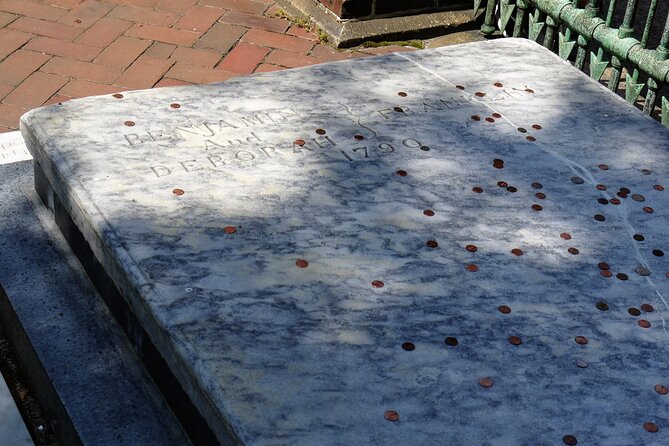
Elfreth’s Alley is one of the most memorable stops because it shifts the story away from government buildings. The narrow brick street has been continuously occupied since the early 1700s and is lined with small historic homes.
The architecture gives you a better sense of ordinary urban life than a grand public building can. Narrow fronts, brickwork, and compact homes show how people lived in a dense colonial city. The stop lasts about 10 minutes and is free to view from the street.
You should expect a photo stop and historical explanation, not a full house tour. Still, this is exactly the kind of place that rewards a slower look after the guided walk. Note the scale of the homes and the tight layout. Philadelphia’s early history was not only made by legislators and generals. It was also lived in streets like this.
Betsy Ross House and the stories behind national symbols
The route passes the Betsy Ross House, associated with the seamstress who is said to have sewn the first American flag. Your guide addresses the myths connected with Betsy Ross rather than presenting the traditional story as settled fact.
That careful approach is valuable. Philadelphia has many polished founding stories, and the best guides explain what is documented, what is disputed, and why the story endured. The house is viewed from outside during the tour, and admission is not included.
This stop works well with the Liberty Bell discussion. Both places show how later generations turned people and objects into symbols. You get a more honest picture when the guide explains the legend as well as the evidence.
Franklin’s grave and the President’s House site
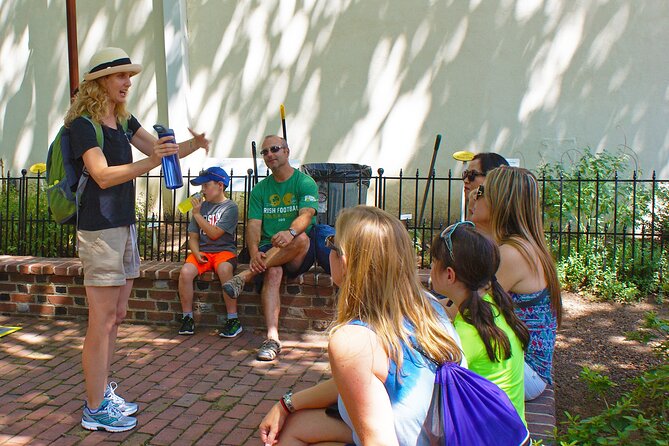
The walk continues past Benjamin Franklin’s grave on Arch Street. Franklin was an inventor, writer, printer, diplomat, and political thinker, and his burial site adds a personal note to the route.
The stop itself is free and takes about 10 minutes. You will not spend long inside a cemetery or museum setting, but the location gives your guide another chance to connect Philadelphia’s civic life with the people who helped shape it.
The President’s House site follows. George Washington and John Adams lived here while serving as president. The site also examines the enslaved people who lived there, an essential part of the story that is often left out of simplified founding narratives.
The active archaeological work at the site adds another layer. You are looking at a downtown location where physical traces of the past still matter. This is a particularly useful stop for anyone who wants the tour to address the gap between the language of liberty and the realities of slavery.
What the guides do especially well
The strongest praise for this experience centers on the guides, not just the route. Tom is repeatedly singled out for his command of facts, energy, and humor. John is praised for answering every question, adding extra information, and keeping children interested. Maria Gorshin is noted for vivid stories about life in the 1700s and for checking in with families during the walk.
Other guides receive similar praise. Caroline is described as clear and attentive, PJ as friendly and informative, and Carla as both personable and well prepared. David is noted for covering a great deal in two and a half hours while offering restaurant suggestions and adapting to the group.
That range of names tells you something useful. The company does not rely on one star guide alone. Your exact experience will depend on who leads your departure, but the recurring pattern is a guide who explains context, welcomes questions, and uses stories instead of reciting dates.
The small group helps. With a maximum of 12 people, you are less likely to lose the guide’s voice or feel like an anonymous face in a crowd. Several guides have adjusted explanations to suit families, history enthusiasts, and people with only a few hours in the city.
Walking pace, timing, and practical limits
The tour lasts about 2.5 hours and covers a lot of ground. The individual stops are usually short, from five to 20 minutes, so the experience keeps moving.
That makes it a good first activity in Philadelphia. You get your bearings quickly and learn which sites deserve a longer return visit. It also suits a short stay. One person with only five hours in the city found the timing particularly useful because it covered the main historical sights without taking the entire day.
The tradeoff is that the information comes quickly. If you want long periods for photographs, quiet reflection, or indoor exhibits, this may feel brisk. Wear comfortable shoes, check the weather, and bring water if conditions are warm. Food and drinks are not included, and there is no scheduled shopping time.
The route is offered in English, with mobile tickets and confirmation at booking. Service animals are allowed, and most people can participate. The tour is near public transportation, but no private transport is provided, so you should expect to walk from the meeting point through the historic district.
Access to historic buildings can also change. Recent conditions have caused some buildings to close, and guides have responded by adding explanations, suggestions, and extra context outdoors. That flexibility is useful, but you should not book this experience assuming every interior will be open.
Is $45 a fair price?
At $45, this is not the cheapest way to walk around Old City. You can see many exteriors on your own for free, including Independence Hall, Carpenters’ Hall, Elfreth’s Alley, and the President’s House site.
The value comes from the guide’s structure and interpretation. You are paying to understand how the sites connect, hear the myths corrected, receive historical context, and see the Washington War Tent presentation. The later museum discount adds another benefit if you use it.
I consider the price fair for a first visit, especially if you have limited time or prefer a guided introduction before exploring alone. It is less compelling for a Philadelphia resident who already knows the main landmarks and only wants museum admission.
The tour also makes a practical donation to a local nonprofit historic organization. That is a modest but worthwhile addition to the experience, especially for visitors who want their sightseeing money to support preservation.
Who should book this Philadelphia walking tour?
I would recommend it to first-time visitors, families with older children, solo visitors, couples, and anyone who wants the major Revolutionary sites explained in one outing. It works especially well for history fans who enjoy asking questions and comparing the official story with the evidence behind it.
Families should find the mix of statues, streets, famous buildings, symbols, and the War Tent easier to follow than a long museum lecture. John and Maria have shown particular care with children and have kept younger participants involved.
You might choose another option if you need full interior access to Independence Hall, the Liberty Bell Center, or multiple historic houses. You may also prefer a slower private tour if you want extensive photography or lengthy stops.
Book at least a little ahead if your schedule is fixed. The experience is often reserved about 31 days in advance, which suggests that popular departure times can fill early. Free cancellation is available if you cancel at least 24 hours before the start time. Cancellations within 24 hours are not refunded.
Should you book it?
Book this tour if you want a lively, efficient introduction to Philadelphia’s founding story, with a small group and a strong guide. The Washington War Tent presentation gives it a feature that many general Old City walks lack, and the museum discount can extend the experience beyond the scheduled 2.5 hours.
Skip it if you mainly want indoor access or prefer to explore every site at your own pace. For most first-time visitors, though, the combination of essential landmarks, careful storytelling, and practical orientation makes this a smart use of half a day in Philadelphia.
FAQ
How long does the Philadelphia history tour last?
The tour lasts approximately 2 hours and 30 minutes.
How much does the tour cost?
The listed price is $45 per person. Group discounts may be available.
Where does the tour begin?
It begins at the statue of The Signer in Signer’s Garden, at 434 to 498 Chestnut Street, Philadelphia, Pennsylvania 19106.
Where does the tour end?
The tour ends in Old City, Philadelphia, in the Historic District.
Is admission to Independence Hall included?
No. Independence Hall is viewed from outside during the tour, and admission is not included.
Do you enter the Liberty Bell Center?
No. The Liberty Bell is discussed from outside, and the tour does not include entry to the Liberty Bell Center.
Is the Museum of the American Revolution included?
The tour includes entry for a presentation featuring George Washington’s War Tent. You also receive a discounted ticket to visit the rest of the museum after the tour.
How many people can join the tour?
The tour has a maximum group size of 12 travelers.
What is the cancellation policy?
You can cancel at least 24 hours before the start time for a full refund. Cancellations or changes made less than 24 hours before the start time are not accepted for a refund.
Recently added around Philadelphia
- Philadelphia: Revolution and The Founders History Tour★ 4.6 · 450 reviews
- Flavors of Philly Food Tour★ 5.0 · 505 reviews
- Double Decker Hop-On Hop-Off City Sightseeing Philadelphia (1, 2, or 3-Day)★ 4.0 · 562 reviews
- Philadelphia 2 Hour Electric Cart Tour★ 5.0 · 633 reviews
- BYOB Historically Hilarious Trolley Tour of Philadelphia★ 5.0 · 657 reviews
- Center City Philadelphia Food Tour with Reading Market★ 5.0 · 861 reviews
- Philadelphia: Double-Decker Hop-on Hop-off Sightseeing Tour★ 4.4 · 868 reviews
- Philadelphia: Eastern State Penitentiary Admission★ 4.7 · 894 reviews
Historical Tours, compared.


History and Hauntings of Salem Guided Walking Tour
Read our review →
Charleston’s Old South Carriage Historic Horse & Carriage Tour
Read our review →

Big Island in a Day: Volcanoes Waterfalls Sightseeing and History
Read our review →
Freedom Trail History Small Group Walking Tour
Read our review →
Historic Charleston Guided Sightseeing Walking Tour
Read our review →
Starship Landmark 90 Minute Sightseeing Cruise
Read our review →Browse the lists this tour appears in