
Reviewed · FREEDOM TRAIL TOURS
Boston: Freedom Trail History Small Group Walking Tour
Boston’s past is under your feet. This 2.5-hour walk is a fine way to meet the city, especially if you want more than quick plaques and photo stops. I like the small group of no more than 16 people, and I like the way guides such as Jon, Maura, Alejandro, Mark, and Maz connect the sites in time order. The main drawback is simple: you spend the full tour outdoors and mostly view buildings from the street, without museum admission included.
The route covers all 16 official Freedom Trail landmarks, from Boston Common to Copp’s Hill Terrace in the North End. At $35.10 per person, I consider it good value if American Revolution history matters to you. You should still allow for standing, city noise, uneven pavement, and cold or wet weather.
In This Review
- Key points at a glance
- Why this Boston history walk works
- Starting at the Boston Foundation Monument
- Boston Common and the public heart of the city
- Granary Burying Ground and Boston’s revolutionary names
- Benjamin Franklin, public education, and Boston politics
- The Boston Massacre Site and the power of a public story
- Faneuil Hall and the road to protest
- North Square, Paul Revere, and the North End
- Old North Church and the final view from Copp’s Hill
- What the $35.10 price buys you
- Weather, walking, and guide style
- Who should book this tour?
- FAQ
- How long is the Boston Freedom Trail walking tour?
- What landmarks are included?
- Where does the tour start and end?
- Is admission to the historic buildings included?
- Is the tour accessible for wheelchairs and strollers?
- What is the cancellation policy?
- Should you book it?
Key points at a glance
- All 16 Freedom Trail landmarks: You follow the complete official route, not just the best-known section.
- A 1760 to 1775 focus: The guide centers on the tense years before the American Revolution.
- Small groups capped at 16: The size gives you a better chance to hear the guide and ask questions.
- A useful North End finish: The tour ends near Hanover Street restaurants, bakeries, and pizza shops.
- Outdoor history with limited entry: Museum and church admission are not part of the $35.10 price.
- Strong guide-led experience: Guides including Jon, Maura, Alejandro, Mark, Maz, and others receive especially warm praise for storytelling and clear answers.
Why this Boston history walk works
The Freedom Trail is easy to follow on your own. A red line runs through the city, and every guidebook explains the basic stops. The hard part is understanding how the sites connect: religion, politics, trade, protest, burial customs, and British military power all meet within a fairly compact part of Boston.
That is where this tour earns its fee. Your guide focuses on the years from 1760 to 1775, when arguments over taxation and authority turned into open resistance. Instead of treating each landmark as an isolated object, the guide can explain how a meeting house, a marketplace, a burial ground, and a street corner each played a role in the growing conflict.
I also like the chance to ask questions as you go. The small group helps here. With a maximum of 16 people, the walk should feel more personal than a large crowd gathered around a flag. The guides are also clearly comfortable with detailed questions, and several have backgrounds in teaching, education, acting, filmmaking, or local history.
The experience earns a 4.9 rating from 6,450 reviews, and 98 percent of customers recommend it. Those figures do not guarantee that every guide or every weather day will suit you, but they do match the strongest pattern: the guide makes the walk memorable.
More Historical Tours in Boston
- Tour of Historic Fenway Park, America’s Most Beloved Ballpark
★ 4.5 · 3,013 reviews - Boston Food & History: Pizza, North End & Freedom Trail
★ 5.0 · 1,772 reviews - Boston: City Cruises Historical Sightseeing Cruise
★ 4.6 · 1,771 reviews
Starting at the Boston Foundation Monument
Meet inside Boston Common at the Boston Foundation Monument, near the northern edge of the park and opposite 50 Beacon Street. Give yourself enough time to locate the monument before the scheduled start. Boston Common has several paths and entrances, so arriving just before departure may leave you rushing.
The granite memorial includes a bronze relief showing two men shaking hands. It recalls the Puritan arrival in 1630, providing a useful starting point before the tour turns toward the revolutionary era.
This opening also gives the guide a chance to explain Boston’s beginnings and the city’s place in Massachusetts history. The tour does not begin with a dramatic battle. It starts with the people, beliefs, and institutions that shaped the town long before 1775.
Boston Common and the public heart of the city
The first major stop is Boston Common, described as the oldest public land in the Americas. In its early years, it served as a communal grazing pasture. Today, it is a city park, but its original purpose tells you a great deal about colonial Boston: shared land was practical, central, and closely tied to daily life.
You spend about 20 minutes here. That may sound generous for a park, but the space gives your guide room to explain Boston’s growth and the public life that later fed political protest.
You will also pass the Massachusetts State Capitol, the 1798 building linked with Boston’s famous Hub of the Solar System nickname. The route then takes in an active church that was the tallest building in 19th-century Boston. These early stops broaden the tour beyond the Revolution itself and show how Boston changed after independence.
The route is city walking, not a country path. You should expect traffic, pedestrians, and regular stops on public sidewalks. Comfortable shoes matter more than stylish ones.
Granary Burying Ground and Boston’s revolutionary names
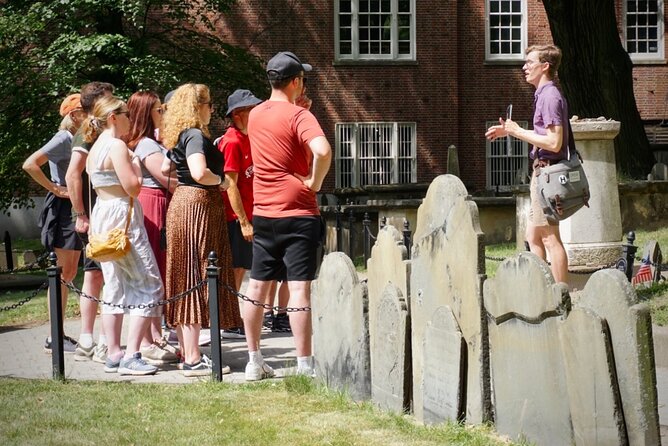
Granary Burying Ground is one of the most important stops on the walk. Founded in 1660, it is Boston’s third-oldest burying ground and the final resting place of several major figures from Revolutionary Boston.
The tour allows about 20 minutes here. That time gives you a chance to take in the old stones and hear why burial grounds are so useful for understanding a city. The names and dates connect public events with real people, families, and generations.
The surrounding section also includes Boston’s oldest burying ground and the first Church of England in Puritan Boston, founded in 1686 and rebuilt in 1754. You will not simply hear a list of dates. The guide uses these places to show the tension between Puritan religious control, changing beliefs, and the arrival of different communities.
The main limitation is that the walking tour does not include admission inside churches or museums. You see the exteriors and hear the stories from the street. If you want to enter the Old South Meeting House, Old North Church, or King’s Chapel, plan a separate visit and budget for admission.
More Walking Tours in Boston
- Cambridge: Harvard University Student-Guided Walking Tour
★ 4.6 · 3,931 reviews - Harvard University Campus Guided Walking Tour
★ 4.5 · 3,632 reviews - Boston Freedom Trail Walking Tour with Costumed Guide
★ 4.5 · 2,531 reviews - The Full Revolutionary Story Epic Small Group Boston Walking Tour
★ 5.0 · 2,356 reviews
Benjamin Franklin, public education, and Boston politics
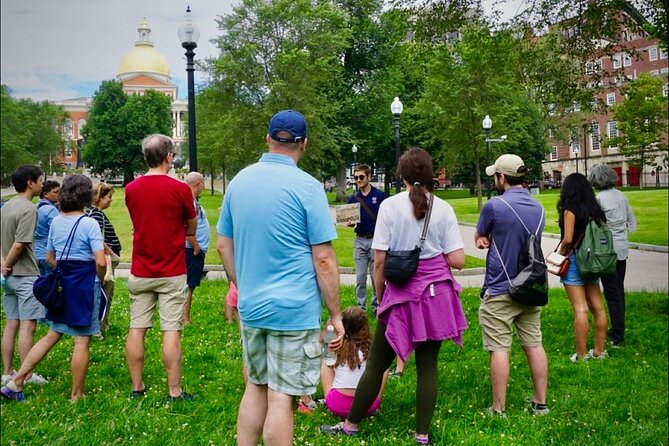
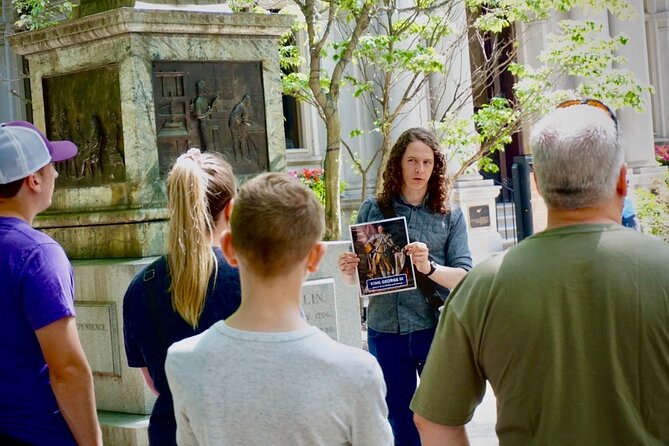
The Statue of Benjamin Franklin marks the site of Boston Latin School, founded in 1635 and described here as the oldest public school in the Americas. Franklin attended the school, although he did not graduate. The stop is brief, about 10 minutes, but it connects a familiar founding-era name with education and civic life.
This part of the route also passes places tied to Boston politics, publishing, and religious meetings. One site served as the center of Boston politics for more than a century. Another was the former publishing house of Ticknor & Fields. A Congregationalist meeting house, founded in 1729, is linked with the origin of the Boston Tea Party in 1773.
These stops help explain why Boston’s resistance did not grow from one angry crowd alone. Political arguments were shaped in meeting houses, printed in publishing offices, and debated in public spaces. You get a better sense of how information moved through the city.
The former colonial capitol of the Massachusetts Bay Colony is another important point. It dates to 1713 and is described as the oldest public building in Boston. The sequence makes good sense: education, politics, religion, printing, and government all appear before the tour reaches the violence of 1770.
The Boston Massacre Site and the power of a public story
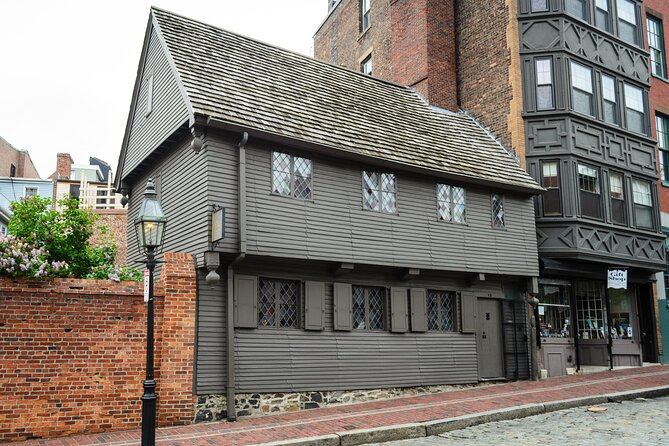
The Boston Massacre Site is one of the route’s most charged stops. In 1770, British soldiers killed five Bostonians. The event became a powerful piece of political messaging, helping turn local anger into a wider argument against British rule.
The tour spends about 20 minutes here. That is enough time for the guide to explain what happened and why the event mattered beyond the deaths themselves. The site also shows how the meaning of an event can be shaped by the people who describe it, print it, and remember it.
You will see the location in a busy part of downtown Boston. Do not expect a quiet memorial garden. The value comes from the explanation, not from a large physical exhibit.
The route also passes the home or site connected with a leading figure of Boston’s Sons of Liberty. This adds political context before the tour moves to Faneuil Hall.
Faneuil Hall and the road to protest
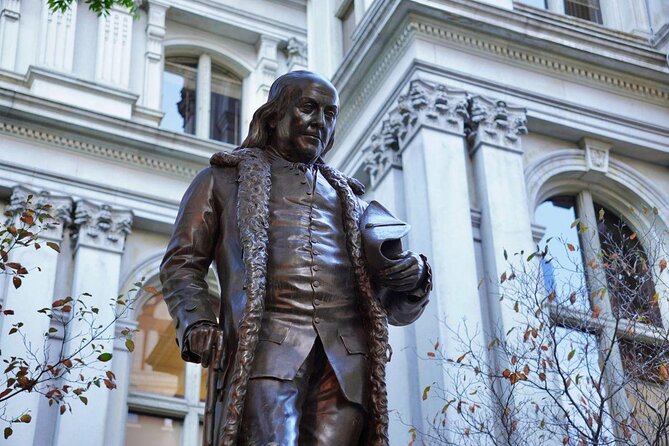
Faneuil Hall dates to 1742 and is known as the Cradle of Liberty. It hosted Boston’s town meetings and remains one of the city’s most recognizable public buildings.
The stop lasts about 10 minutes. Your guide can explain how public debate worked in colonial Boston and why a meeting hall could become a force in the fight over imperial authority.
Nearby, the route passes the oldest restaurant in the United States, located in a historic building dating to 1704. The restaurant itself dates to 1826, so this stop is not about the American Revolution alone. It gives you a glimpse of how later Boston preserved and reused its old buildings.
This is a good place to remember that the Freedom Trail is both a history route and a working downtown district. Shops, restaurants, offices, and crowds share the same streets. That can make the walk feel authentic, but it also means you will not have a museum-like setting at every stop.
North Square, Paul Revere, and the North End
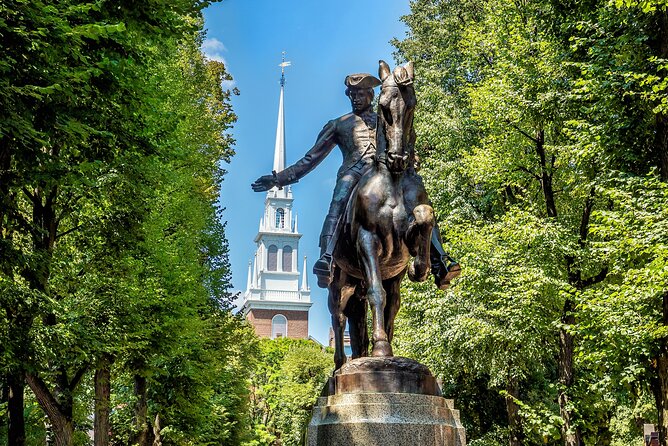
North Square Park brings you into the heart of Boston’s North End. The square dates to 1634 and remains one of the most atmospheric public spaces on the route.
You spend about 20 minutes here before reaching the Paul Revere House. Built in 1680, it is the oldest structure in Downtown Boston and Revere’s former home. The house is one of the clearest links between a surviving building and the events of 1775.
Again, the tour does not include entry inside. You can decide later if the Paul Revere House deserves its own visit. For many people, it does, since the exterior view cannot show the rooms, furnishings, or cramped scale of the building.
The Paul Revere Statue and nearby pedestrian area honor the famous Midnight Ride. The guide can help separate the familiar legend from the larger history around it. Revere was not simply a lone rider in a dramatic story. His role fits into a network of messengers, local leaders, and organized resistance.
This is also the point where food becomes part of your planning. The tour ends near Hanover Street, where you can find Italian restaurants, pastry shops, pizza, and other North End choices. I would not book a tight meal reservation before the tour ends, but the location is excellent for lunch or dinner afterward.
Old North Church and the final view from Copp’s Hill
The route continues to Boston’s oldest church, which held the signal lanterns associated with Paul Revere’s Midnight Ride. This is one of the most recognizable moments on the Freedom Trail, and the guide’s storytelling matters a great deal here.
You also pass Boston’s second-oldest burying ground before reaching Copp’s Hill Terrace. The final stop lasts about 20 minutes and provides a broad view toward the Charles River, the U.S.S. Constitution, and the Bunker Hill Monument.
The ending is well chosen. You finish with a view toward two major landmarks that are not included in this tour’s route through Charlestown. The U.S.S. Constitution dates to 1797, while the Bunker Hill Monument recalls the 1775 battle. You can use the view to plan another outing, but Charlestown is specifically not included in this experience.
Copp’s Hill Terrace is at 520 Commercial Street in the North End. From there, you are close to Hanover Street and public transportation. The tour does not return you to Boston Common, so plan your next move from the North End rather than assuming a circular route.
What the $35.10 price buys you
At $35.10 per person, this is not the cheapest way to walk the Freedom Trail. You can follow the red line independently at no charge. The question is what you want from the experience.
I see good value in the tour if you want a clear historical framework and a guide who can answer questions. The price covers about two and a half hours, all 16 official landmarks, and a group limited to 16 people. It also saves you the work of researching every site before you arrive.
The price does not cover admission to museums or churches, gratuity, or the Charlestown neighborhood. If you plan to enter several buildings, the total cost will rise. Old South Meeting House and Old North Church offer discounted admission with a Hub Town Tour ticket, and King’s Chapel is expected to offer the same discount soon. Confirm current details when booking.
For a first Boston visit, I would treat this as an orientation and history tour, not a complete museum experience. You can return to the sites that interest you most after the walk.
Weather, walking, and guide style
You need a moderate level of physical fitness. The walk lasts around 2.5 hours, and you may stand for extended periods. The route is wheelchair and stroller accessible, and service animals are allowed, but accessibility does not remove the need for city walking and outdoor waiting.
Boston weather can change the experience. Winter feedback repeatedly highlights freezing temperatures, wind, and the need to bundle up. Guides have used indoor or covered spaces when possible, and one report specifically noted an indoor warm-up break halfway through. Still, you should dress for an outdoor tour rather than count on long indoor periods.
The guide is the heart of the experience. Jon is praised for taking the story in chronological order and delivering a strong final speech. Maura is noted for vivid storytelling. Alejandro is especially attentive to cold-weather comfort and group interaction. Mark, Maz, Nick, Meaghan, Kiera, Miles, Amelia, Cal, Cyrus, and Will are also praised for clear explanations, enthusiasm, and a strong command of Boston history.
There was one delayed departure after an original guide failed to arrive, though a replacement guide took over and the group still received a highly successful tour. That appears to be an unusual situation, not a normal feature, but it is a reminder to keep a little flexibility in your first-day schedule.
Who should book this tour?
I would choose this walk for:
- First-time Boston visitors who want a strong orientation
- People interested in the American Revolution
- Families with older children and teenagers who can manage a long walk
- Solo visitors who want an informed guide and a small group
- Anyone who prefers stories and questions over reading plaques alone
I would think twice if you dislike standing, need frequent indoor breaks, or want to see the interiors of several historic buildings during the same outing. A self-guided walk with separate museum visits may suit you better.
Book at least a few weeks ahead if your schedule is fixed. The tour is booked an average of 22 days in advance, and small groups can fill. You receive confirmation at booking, and free cancellation is available up to 24 hours before the start time. If poor weather or an insufficient number of bookings cancels the tour, you can choose another date or receive a full refund.
FAQ
How long is the Boston Freedom Trail walking tour?
The tour lasts approximately 2 hours and 30 minutes.
What landmarks are included?
The tour covers all 16 official historic landmarks on the Freedom Trail, including Boston Common, Granary Burying Ground, the Benjamin Franklin Statue, the Boston Massacre Site, Faneuil Hall Marketplace, North Square Park, the Paul Revere House, the Paul Revere Statue, and Copp’s Hill Terrace.
Where does the tour start and end?
It starts at the Boston Foundation Monument inside Boston Common, near 49 Beacon Street. It ends at Copp’s Hill Terrace at 520 Commercial Street in the North End.
Is admission to the historic buildings included?
No. Admission inside museums and historic churches is not included in the tour price.
Is the tour accessible for wheelchairs and strollers?
Yes. The experience is wheelchair and stroller accessible. You should still be prepared for extended standing and city walking.
What is the cancellation policy?
You can cancel at least 24 hours before the start time for a full refund. Cancellations or changes made within 24 hours are not refunded or accepted. Poor weather or failure to meet the minimum group size may result in another date or a full refund.
Should you book it?
Book this tour if you want Boston’s Freedom Trail to make sense, not just appear as a string of old buildings. The route is full, the group is small, and the best guides turn colonial politics into a story you can follow from Boston Common to the North End.
I would schedule it early in your Boston stay, then return to the interiors that catch your interest. Wear good shoes, dress for the forecast, and keep your evening open after Copp’s Hill Terrace. At $35.10, it is a sensible first look at Boston’s revolutionary center, especially for history fans and first-time visitors.
More Historical Tours
- City Cruises Boston Historic Sightseeing Harbor Cruise
★ 4.5 · 1,388 reviews - Boston’s North End Food Tour: Italian Flavors & Heritage Walk
★ 5.0 · 1,322 reviews - Boston Pizza Lovers Food and History Walking Food Tour
★ 4.5 · 1,082 reviews - Delicious Donuts of Boston: A Sweet History Walking Tour
★ 5.0 · 1,038 reviews
More Freedom Trail Tours
- Boston’s Freedom Trail: A Revolutionary Walking Tour
★ 4.9 · 1,748 reviews - Boston: Freedom Trail History Small Group Walking Tour
★ 4.9 · 1,590 reviews - Boston’s Freedom Trail: A Revolutionary Walking Tour
★ 5.0 · 1,343 reviews - Freedom Trail Walking Tour 250
★ 4.5 · 1,118 reviews
Recently added around Boston
- Boston’s Politically Incorrect North End Food Tour★ 5.0 · 453 reviews
- Boston’s North End Food and History Walking Tour★ 5.0 · 459 reviews
- Downtown Freedom Trail, Beacon Hill & Back Bay Walking Tour★ 4.5 · 473 reviews
- Cambridge, Massachusetts: MIT and Harvard Walking Tour★ 4.7 · 486 reviews
- Narrated Sunset Cruise of Boston Harbor★ 4.0 · 532 reviews
- Sightseeing Day Sail around Boston Harbor★ 5.0 · 541 reviews
- Boston: Harbor Sunset Yacht Cruise★ 4.6 · 570 reviews
- Boston: Martha’s Vineyard Day Trip with Optional Island Tour★ 4.6 · 573 reviews
Freedom Trail Tours, compared.
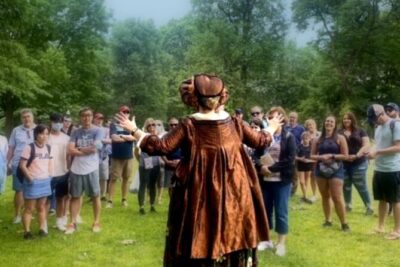
Boston Freedom Trail Walking Tour with Costumed Guide
Read our review →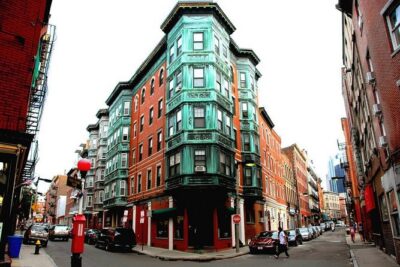
Boston Food & History: Pizza, North End & Freedom Trail
Read our review →
Boston’s Freedom Trail: A Revolutionary Walking Tour
Read our review →
Freedom Trail History Small Group Walking Tour
Read our review →Boston’s Freedom Trail: A Revolutionary Walking Tour
Read our review →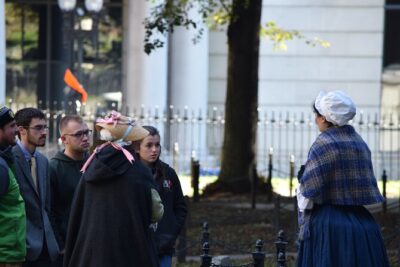

Boston Freedom Trail History Pub Crawl Small-Group Tour
Read our review →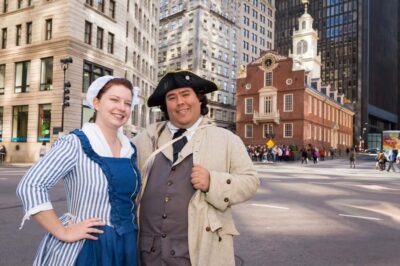
Browse the lists this tour appears in