
Reviewed · WALKING TOURS
Historic Charleston Guided Sightseeing Walking Tour
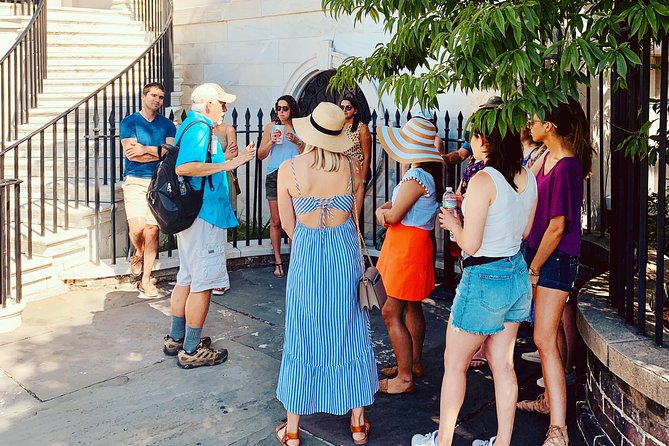
Charleston’s story is best read on foot. This two-hour walk links City Hall, the French Quarter, Rainbow Row, and White Point Garden, giving you a clear first look at the city’s architecture, politics, churches, waterfront, and difficult past. I like the route because it covers a lot without turning into an all-day march, and I like the local guides, who bring the streets to life with stories rather than a dry list of dates. The main drawback is that you do not enter every landmark, and the exact stops can change with the guide and route.
I also like the easy downtown meeting point and the number of available departure times. Guides such as Evans Byrd, Al, Dennis, and Duggar have earned strong praise for clear storytelling, humor, architecture knowledge, and useful restaurant suggestions. You should still arrive early, bring water, and prepare for heat, rain, or cold because the tour runs outdoors in all weather unless conditions become unsafe.
In This Review
- Key points to know before you book
- Starting at Charleston City Hall and the Four Corners of Law
- The French Quarter in 45 minutes
- Rainbow Row and the short waterfront stop
- South of Broad and the Battery
- What the guides add to the experience
- Why two hours is a useful length
- Is the $30 price good value?
- Weather, shoes, and daily planning
- Who should book this Charleston walk?
- Should you book the Historic Charleston Guided Sightseeing Walking Tour?
- FAQ
- Where does the Historic Charleston walking tour begin?
- Where does the tour end?
- How long does the tour last?
- What landmarks are included?
- Is admission to the historic buildings included?
- What should I bring?
- What happens if the tour is canceled because of bad weather?
Key points to know before you book
- Four Corners of Law starting point: Meet at Charleston City Hall, near the courthouse, post office, and St. Michael’s Church.
- A strong first-day introduction: The route connects major landmarks in the French Quarter and South of Broad in only two hours.
- History and architecture together: Guides explain not just who lived here, but why Charleston’s homes and public buildings look the way they do.
- A flat, moderate walk: The route has no hills, but you will remain on your feet for about two hours.
- Outdoor planning matters: Water is not supplied, public restrooms are scarce along the route, and weather can affect operations.
- Small-group format: The maximum group size is 20 people, which should make it easier to hear and ask questions.
Starting at Charleston City Hall and the Four Corners of Law
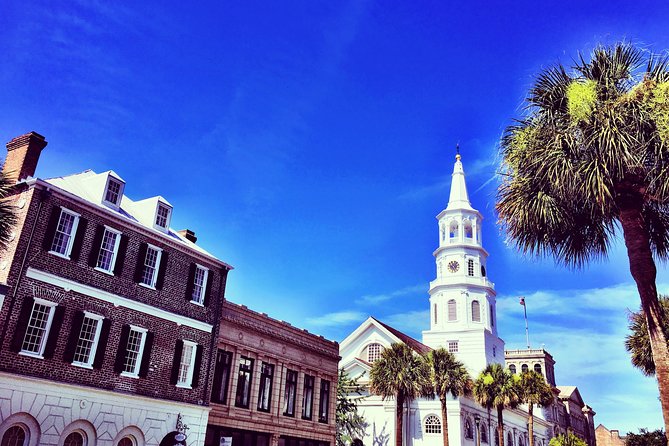
The tour begins at 80 Broad Street, in front of Charleston City Hall. This is a useful starting place because you are immediately surrounded by several buildings that explain how the city worked.
The intersection of Broad and Meeting streets is known as the Four Corners of Law. Charleston City Hall represents municipal government. Nearby, you can see the courthouse, post office, and St. Michael’s Church, which is associated with George Washington’s worship in Charleston.
Your guide uses this opening stretch to set the scene for the peninsula. It is more useful than simply snapping a photo of City Hall, since you begin to see Charleston as a city shaped by civic power, religion, commerce, and conflict.
Plan to arrive 15 minutes early. The tour begins promptly, and finding the guide at a busy downtown intersection can take a moment. The meeting point is near public transportation, and parking is available in downtown garages and open-air lots. The recommended garage is at 85 Queen Street, though parking costs are not included in the $30 tour price.
More Historical Tours in Charleston
- Charleston’s Old South Carriage Historic Horse & Carriage Tour
★ 5.0 · 10,023 reviews - Charleston Horse-Drawn Carriage Tour: Explore Historic Charleston
★ 5.0 · 3,561 reviews - Charleston Harbor History Day-Time or Sunset Boat Cruise
★ 4.5 · 2,788 reviews
The French Quarter in 45 minutes
The longest portion of the walk takes you through the French Quarter. This is where the tour earns much of its value, since several major sites are close together but can feel disconnected when you explore alone.
The Dock Street Theatre is one of the headline stops. It is presented as America’s first theatre, giving the guide a chance to explain Charleston’s early entertainment culture and the importance of public performance in the city’s social life. You view the building from outside rather than receiving an included interior visit, so think of this as a history and architecture stop, not a theatre admission.
St. Philip’s Church adds another layer to the neighborhood. The church, like St. Michael’s, points to the role of religion in Charleston’s public life and changing community. The French Huguenot Church offers a different thread, connecting the district to the city’s French Protestant roots.
You will also pass the Powder Magazine, an old military structure that helps explain the strategic importance of Charleston. The Old Exchange Building, described as South Carolina’s most historic building, is another important point of interest in the broader route, although the exact sequence of stops may vary.
The Slave Mart Museum is particularly important. You may see the building from outside, and the guide discusses Charleston’s role in slavery and the people affected by that system. This is not a substitute for a full museum visit, but it gives you a necessary foundation for understanding the city beyond its handsome houses and church steeples.
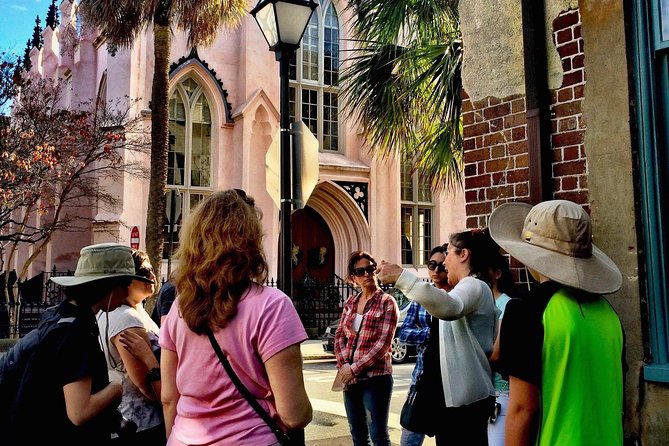
The Pink House brings the tour back to architecture and atmosphere. Its small scale and distinctive appearance contrast with the larger homes nearby. A good guide can use such buildings to show how Charleston’s streets contain many different types of homes, businesses, and public spaces.
The exact stops are not guaranteed. That is worth keeping in mind if one specific building is your top priority. The strength of the French Quarter section is the overall connection between sites, not a promise that every landmark will receive equal time.
Rainbow Row and the short waterfront stop
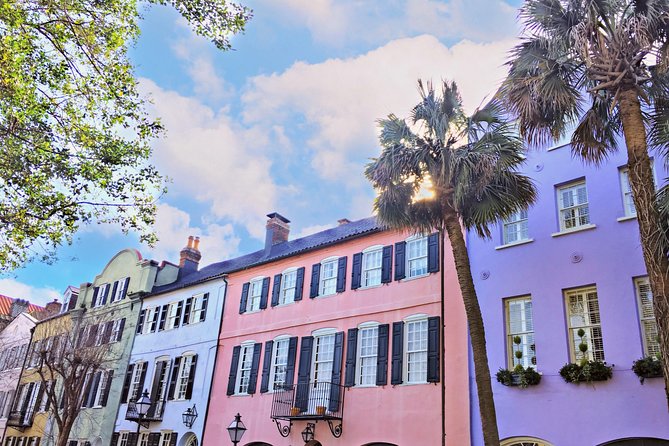
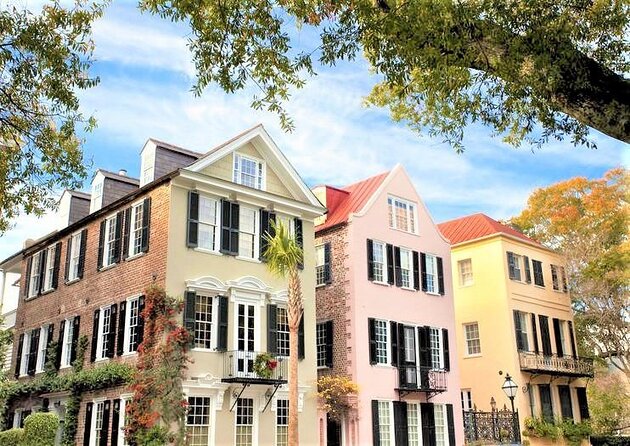
Rainbow Row is one of Charleston’s most photographed stretches, a line of 13 colorful houses along the waterfront. You spend about 10 minutes here, enough to see the façades and hear how the row fits into the South of Broad neighborhood.
This is a quick stop, so do not expect a long architectural lecture or an opportunity to enter the houses. The value is in seeing Rainbow Row as part of a larger district rather than treating it as an isolated photo backdrop.
The homes around here also help prepare you for the next section of the walk. Charleston’s appeal comes from the way individual houses, narrow streets, churches, gardens, and waterfront views work together. Your guide can point out details you might miss while wandering alone, including the reasons behind certain designs and how the buildings were repaired after storms and hurricanes.
South of Broad and the Battery
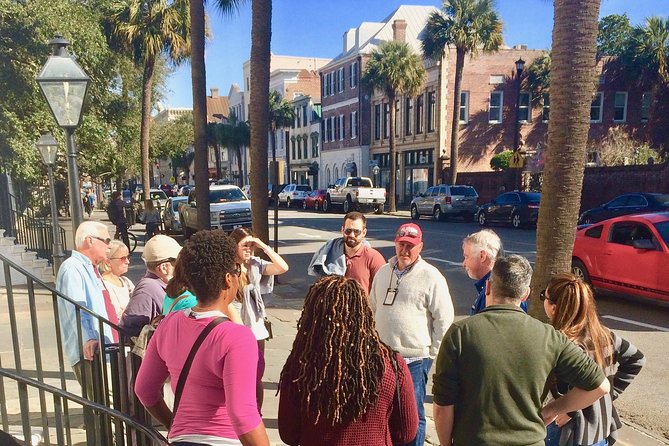
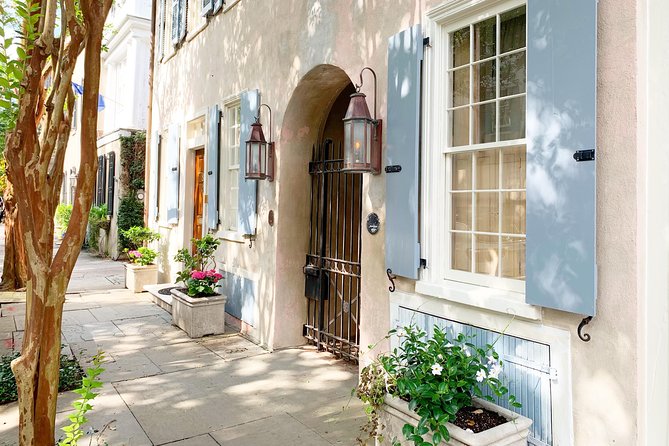
The route continues into South of Broad, Charleston’s residential area of historic homes and antebellum mansions. This is a quieter, more residential side of the peninsula, and it gives you a chance to move beyond the busiest sightseeing streets.
The Battery is the city’s waterfront defensive promenade. The tour does not cover its entire length, so you should not expect a complete Battery walk. Instead, your guide takes you to selected points, depending on the route and timing.
White Point Garden is the natural high point of this section. The park sits at the southern end of the historic district and offers open views across the water toward Fort Sumter. You can connect Charleston’s streets to the harbor, where military events, trade, and coastal weather all shaped the city.
This is also where the pace may feel most relaxed. One recent account described the walk as moderate and comfortable, while another noted that the route is flat with no hills. Still, flat does not mean effortless. Charleston’s summer heat can make two hours outside feel longer, especially when there are few places to buy water.
Bring your own bottle. Water is not provided, and there are very few places to purchase it along the route. You should also use a restroom before arriving, since there are no public restrooms along the walking route.
More Walking Tours in Charleston
- Ghosts of Charleston Night-Time Walking Tour with Unitarian Church Graveyard
★ 4.5 · 2,835 reviews - Hidden Alleyways and Historic Sites Small-Group Walking Tour
★ 5.0 · 2,335 reviews - Highlights of Charleston Guided Walking Tour
★ 5.0 · 2,206 reviews - Charleston Haunted Booze and Boos Ghost Walking Tour
★ 5.0 · 1,569 reviews
What the guides add to the experience
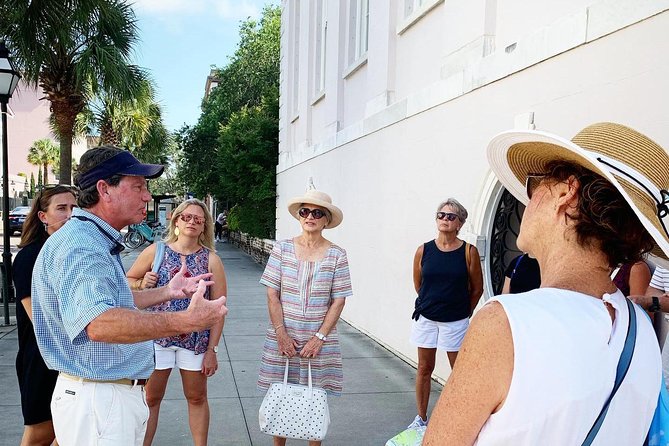
The guide is the most important variable on this tour. The route gives you the setting, but the storytelling determines whether the walk feels like a useful introduction or just a parade of façades.
Evans Byrd has been praised for connecting specific places to the Revolutionary War, the British resistance, the Civil War era, and the restoration of Charleston after the war. That kind of connection is exactly what makes a walking tour worthwhile. Instead of hearing disconnected facts, you begin to understand how events changed the streets around you.
Al is known for humor, architecture details, local facts, and answering questions. His explanations also include the effects of storms and hurricanes on Charleston’s buildings. That is valuable because the city’s appearance is not simply the result of old construction. Preservation and repair are part of the ongoing story.
Dennis is praised for clear communication, wit, and storytelling that draws you into the past. Duggar is described as personable and entertaining, with a background as a retired Citadel college basketball coach. He has also provided restaurant suggestions, which can be useful when you are deciding where to eat after the tour.
The operator does not promise that you can select a particular guide. The names above give you a sense of the range of strengths you might encounter, not a guarantee of assignment. The consistently high rating, 4.9 from 6,216 reviews, and recommendation rate of 98 percent suggest that guide quality is generally a major strength.
Why two hours is a useful length
Two hours is long enough to establish Charleston’s basic story but short enough to fit into a busy visit. I would especially consider booking it on your first day, since the route can help you decide which churches, museums, homes, or waterfront areas deserve a longer return visit.
The tour also gives you a practical sense of distance. You learn how the French Quarter relates to Rainbow Row and how South of Broad connects to the Battery. That helps you plan later walks without repeatedly checking a map.
The tradeoff is depth. You cannot fully explore every landmark in 120 minutes. Admission fees are not included, and the advertised route is primarily an exterior sightseeing experience. If you want to spend serious time inside the Old Exchange Building, Slave Mart Museum, Dock Street Theatre, or another site, plan a separate visit.
The group limit is 20 people. That is not a private tour, but it is more manageable than a large coach group. You should have a reasonable chance to hear the guide and ask questions, especially if everyone gathers closely at each stop.
Is the $30 price good value?
At $30 per person, this is a sensible price for a guided introduction to central Charleston. You are paying for two hours with a licensed local guide, not for museum tickets or transportation. The value comes from the route and interpretation.
I think the price works best if you are new to Charleston and want orientation before exploring on your own. A guide can explain why a building matters, point out the city’s connections to major American events, and offer suggestions for the rest of your stay. Several guides also share local food recommendations, which adds practical value beyond the walk itself.
The price is less compelling if you already know Charleston well or prefer to move at your own pace. You can see many exterior landmarks independently, and the tour does not include entry to the major buildings. Still, the historical connections and chance to ask questions make the fee reasonable for a first visit.
Weather, shoes, and daily planning
This is an outdoor tour that operates in all weather conditions, except when conditions become dangerous. Check the forecast before you leave your hotel and dress for the actual conditions, not the season printed on your itinerary.
Comfortable walking shoes are essential. The route is flat, but you will be walking and standing for about two hours. A water bottle is equally important, especially in summer. Water is not supplied, and buying it during the route may be difficult.
Rain can change the feel of the experience without necessarily canceling it. The policy is generally rain or shine, but dangerous weather can lead to a cancellation, rescheduling, or full refund. If you are traveling with a group booked under different names, contact the operator so everyone can be assigned to the same guide.
Most people can participate, and service animals are allowed. The end point can vary based on the guide and route. If you want to return to the starting point, the guide will walk you back when requested.
Who should book this Charleston walk?
I would recommend this tour to first-time visitors, couples, families, solo explorers, and anyone who likes history explained in plain language. It is also a good match for people who want a moderate walk rather than a demanding full-day outing.
History fans should pay close attention during the French Quarter and Slave Mart Museum section. Architecture fans will get more from the route if they ask about house design, preservation, storms, and the difference between public buildings and private homes.
Families may appreciate the two-hour length and flat route. The mix of churches, colorful houses, waterfront views, military history, and local stories keeps the walk varied. The tour is also a good way to help older children understand that Charleston’s beauty and its painful past are part of the same story.
You may want a different experience if your main goal is entering historic buildings, visiting museums at length, or walking the entire Battery. In that case, use this tour as an introduction and save time afterward for independent visits.
Should you book the Historic Charleston Guided Sightseeing Walking Tour?
Book it if you want a well-paced first look at Charleston with a guide who can connect architecture, religion, war, slavery, civic life, and the waterfront. The route covers the city’s essential historic core, and the strongest guides add humor, clear explanations, and useful suggestions for the rest of your stay.
I would book it early in your visit, arrive 15 minutes ahead, wear good shoes, and carry water. Remember that the route and stops can change, and landmark admission is not included. With those expectations in place, $30 buys a practical and engaging introduction to Charleston that is difficult to match by simply wandering alone.
FAQ
Where does the Historic Charleston walking tour begin?
The tour begins at 80 Broad Street in front of Charleston City Hall, Charleston, South Carolina.
Where does the tour end?
The ending point is in South of Broad, but it can vary according to the guide and route. The guide will walk you back to the starting point if you request it.
How long does the tour last?
The guided walk lasts approximately two hours.
What landmarks are included?
The route generally includes Charleston City Hall, the Four Corners of Law, French Quarter landmarks, Rainbow Row, South of Broad, the Battery, and White Point Garden. Stops can vary by guide and route.
Is admission to the historic buildings included?
No. The experience is a sightseeing walking tour, and admission tickets to individual landmarks are not included.
What should I bring?
Bring comfortable walking shoes and a water bottle. Water is not provided, and there are very few places to purchase it during the tour. You should also use the restroom before the walk because there are no public restrooms along the route.
What happens if the tour is canceled because of bad weather?
If dangerous weather causes a cancellation, you will be offered another date or a full refund. For your own cancellation, you can receive a full refund if you cancel at least 24 hours before the start time.
More Walking Tours
- Charleston’s Pleasing Terrors Night-Time Walking Ghost Tour
★ 5.0 · 1,345 reviews - Charleston Ghost & Graveyard Night-Time Guided Walking Tour
★ 4.5 · 1,100 reviews - Savor the Flavors of Charleston Walking Food Tour
★ 4.5 · 881 reviews - Charleston: Old Walled City Historical Walking Tour
★ 4.7 · 705 reviews
More Historical Tours
- Charleston: Daytime or Sunset Historic Harbor Cruise
★ 4.5 · 1,352 reviews - Charleston historical walking tour with a Professor of History at The Citadel
★ 5.0 · 1,284 reviews - Charleston: Historical Downtown Tour by Horse-drawn Carriage
★ 4.8 · 1,009 reviews - Undiscovered Charleston: Half Day Food, Wine & History Tour with Cooking Class
★ 5.0 · 948 reviews
Recently added around Charleston
- Boone Hall Plantation Admission & Tour with Transportation from Charleston★ 4.5 · 455 reviews
- Charleston: Downtown Horse-Drawn Carriage Tour★ 4.8 · 459 reviews
- Charleston Horse & Carriage Historic Sightseeing Tour★ 4.5 · 460 reviews
- Charleston Ghosts of Liberty Guided Walking Tour★ 4.5 · 473 reviews
- Charleston Ghost & Dungeon Night-Time Walking Tour with Entry to Provost Dungeon★ 4.0 · 479 reviews
- Charleston Haunted Jail Night-Time Walking Tour with Admission to Old City Jail★ 4.5 · 570 reviews
- Charleston Harbor Luxury Dinner Cruise with Live Music★ 4.0 · 607 reviews
- Afternoon Schooner Sightseeing Dolphin Cruise on Charleston Harbor★ 4.5 · 620 reviews
Walking Tours, compared.

History and Hauntings of Salem Guided Walking Tour
Read our review →
New Orleans Premier Ghost, Voodoo and Vampire Walking Tour
Read our review →


Freedom Trail History Small Group Walking Tour
Read our review →
New Orleans Food Walking Tour of the French Quarter with Small-Group Option
Read our review →
St. Louis Cemetery No. 1 Official Walking Tour
Read our review →
Cambridge: Harvard University Student-Guided Walking Tour
Read our review →Browse the lists this tour appears in