

Reviewed · WALKING TOURS
Charleston historical walking tour with a Professor of History at The Citadel
Charleston rewards curious walkers. This three-hour tour turns its streets, churches, squares, and harbor views into a carefully connected lesson led by Eric Lager, Ph.D., a history professor at The Citadel. You move through the old city in a group capped at 12, with plenty of chances to ask questions and follow a topic that catches your interest.
I especially like the small group size and the guide’s academic background. You are not simply handed a list of dates. The tour connects buildings to political disputes, religious communities, architecture, the American Revolution, and the Civil War. The main consideration is pace: three hours on foot, with a large amount of material, can feel demanding if you prefer a light, leisurely stroll.
This is also a tour for people who want substance. Eric has been praised for his humor, warmth, and ability to explain roughly 400 years of Charleston’s past without losing the group. Still, you should bring water, wear sensible shoes, and remember that Fort Sumter is viewed from the Battery rather than visited by boat.
In This Review
- Key points to know before booking
- Why Eric Lager’s teaching style matters
- Starting at Mills House and Dock Street Theater
- The Pink House and Washington Square
- City Hall and the old South Carolina statehouse
- St. Michael’s Church and the Heyward-Washington House
- The Old Exchange, French Huguenots, and the French Quarter
- Hibernian Hall and the road to the Civil War
- Fort Sumter from the Battery
- What the three hours feel like
- Is $40 a fair price?
- Who should book this Charleston walk?
- My verdict: book it if you want Charleston explained
- FAQ
- How long does the Charleston history walk last?
- Where does the tour begin?
- Where does the tour end?
- How large is the tour group?
- Who leads the tour?
- Is Fort Sumter visited directly?
- Are attraction admission fees included?
- Is bottled water provided?
- What happens if bad weather cancels the tour?
Key points to know before booking
- A true small-group walk: The maximum group size is 12, making it easier to hear Eric and ask detailed questions.
- Led by a Citadel professor: Eric Lager holds a Ph.D. and teaches history at The Citadel, giving the walk unusual academic depth.
- A broad Charleston story: The route moves from early settlement and religious life to the Revolution, the Constitution, and the Civil War.
- Thirteen carefully chosen stops: Churches, civic buildings, private homes, theaters, the French Quarter, and the harbor all have a place.
- A strong first-day activity: The route ends near Rainbow Row on the Battery, giving you useful ideas for further exploring Charleston.
- Plan for three hours outdoors: Water is not included, transportation is not provided, and moderate physical fitness is advised.
Why Eric Lager’s teaching style matters

Many city walks give you a handful of dates and a few colorful anecdotes. This one aims higher. Eric’s background in American and European nineteenth-century history helps him explain not only what happened, but also why a building, square, or church mattered at the time.
That difference is important in Charleston. A pretty façade can hide a political quarrel, a change in trade, a religious migration, or a painful connection to slavery and war. The tour’s strongest quality is its effort to connect those subjects instead of treating every stop as an isolated postcard.
You can also ask questions as you walk. The small group makes this practical. Several comments about the tour praise Eric’s ability to handle tangential questions, from architecture and politics to the Civil War and Charleston’s place in the wider United States. If you already know the basics, you can ask for more detail. If you are starting from scratch, you can follow his larger explanation.
His delivery matters, too. The feedback repeatedly points to humor, approachability, and a conversational manner. That keeps a serious subject from becoming a three-hour lecture on a sidewalk. The information comes quickly, but the tone is friendly rather than formal.
More Historical Tours in Charleston
- Charleston’s Old South Carriage Historic Horse & Carriage Tour
★ 5.0 · 10,023 reviews - Historic Charleston Guided Sightseeing Walking Tour
★ 5.0 · 6,216 reviews - Charleston Horse-Drawn Carriage Tour: Explore Historic Charleston
★ 5.0 · 3,561 reviews
Starting at Mills House and Dock Street Theater
The walk begins at 108 Meeting Street, outside Mills House Charleston. This hotel is not just a convenient meeting point. It played a role during the early part of the American Civil War, giving Eric a useful opening for discussing Charleston’s position before and during the conflict.
You spend about 10 minutes here. That is enough time for the basic story without using too much of the walk on one site. From here, the route reaches Dock Street Theater, another 10-minute stop.
Dock Street Theater is tied to the first theater built in North America and to some colorful figures from Charleston’s past. The point is not simply to admire the building. Eric uses it to show how entertainment, status, and public life worked in an old port city.
This early part of the route sets the tone. Charleston’s story is not presented as one long march toward the Civil War. You begin with urban life, buildings, and people, then build toward the larger political crisis.
The Pink House and Washington Square
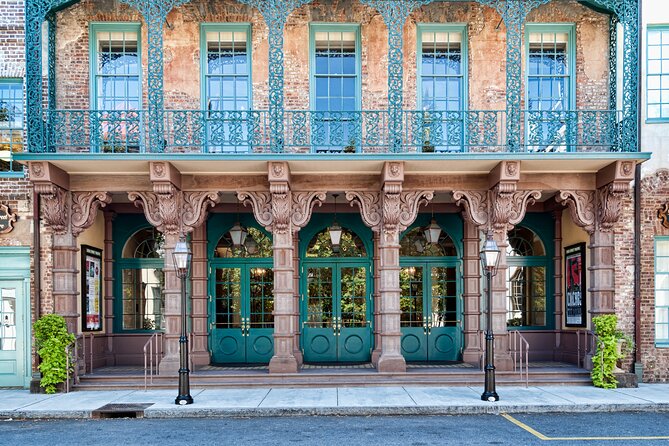
The Pink House Gallery receives a short five-minute visit. Dating to about 1712, it is one of Charleston’s oldest buildings. The stop is brief, but it gives you a chance to see how much of the city’s early character survives in a compact structure.
You then spend about 15 minutes at Washington Square. This historic square contains several monuments and provides a natural pause in the walk. It is also a good place to consider how Charleston has chosen to remember its past in public spaces.
That question of memory runs through the whole experience. Monuments and civic buildings do not tell the entire story on their own. Eric’s role is to add the political and social context that a quick photograph cannot provide.
If you enjoy architecture, this stretch should appeal to you. The tour does not treat design as decoration alone. Building styles, public uses, and changes over time all help explain Charleston’s development.
City Hall and the old South Carolina statehouse
Charleston City Hall is next, with about 10 minutes devoted to its unusual evolution. The building once served as a meat market and later as a bank before becoming City Hall.
That sequence gives you a practical look at how the city changed as its government and economy developed. A building can shift purpose as the city grows, and this site makes that process visible.
The Charleston County Courthouse follows. Here, Eric discusses what was once the old South Carolina statehouse. This is one of the route’s most useful political stops because it moves the story from individual buildings to the institutions that shaped the colony and state.
You may find that this section requires concentration. The walk covers a great deal, and civic history can include names and events that are less familiar than a church or famous house. The benefit is that you leave with a clearer sense of Charleston as a place where state and national decisions were made, not just a town of attractive streets.
More Walking Tours in Charleston
- Ghosts of Charleston Night-Time Walking Tour with Unitarian Church Graveyard
★ 4.5 · 2,835 reviews - Hidden Alleyways and Historic Sites Small-Group Walking Tour
★ 5.0 · 2,335 reviews - Highlights of Charleston Guided Walking Tour
★ 5.0 · 2,206 reviews - Charleston Haunted Booze and Boos Ghost Walking Tour
★ 5.0 · 1,569 reviews
St. Michael’s Church and the Heyward-Washington House
St. Michael’s Church receives about 10 minutes. Completed in 1761, it is Charleston’s oldest church edifice. The stop opens discussion of religion, early civic life, and the place of churches within the city’s public identity.
The French Huguenot presence later in the route adds another religious layer, so St. Michael’s is not a one-off church visit. Together, these sites show that Charleston’s population and institutions were shaped by different traditions.
The Heyward-Washington House is another 10-minute stop. George Washington stayed here during his 1791 visit to Charleston. Admission to the house is not included, so this tour focuses on seeing the site and hearing its story rather than providing an interior visit.
That distinction is worth noting before you book. The experience is primarily a street-level history walk. You will see several important buildings, but you should not expect admission to every interior.
The Old Exchange, French Huguenots, and the French Quarter
At the Old Exchange and Provost Dungeon, the guide discusses the last public building built by the British in North America and the location connected with South Carolina’s ratification of the Constitution in 1788. The scheduled stop is about five minutes, so Eric has to make the key points efficiently.
The Provost Dungeon gives the site a darker edge, while the constitutional connection places Charleston inside the founding story of the United States. This is one of the places where a short stop can carry a lot of weight.
The French Huguenot Church receives about 10 minutes. You learn about the French Huguenots in Charleston and see the first church built in the Gothic Revival style. For anyone interested in religion, immigration, or architecture, this is one of the more distinctive stops.
The 15-minute walk through the French Quarter then lets you take in the area’s streets and buildings as a connected neighborhood. Rather than stopping at one landmark and moving on, you get time to appreciate the overall feel of this part of Charleston.
The French Quarter is also where the tour’s mix of subjects works well. Religious history, building design, public life, and street patterns overlap here. You get more from the neighborhood if you understand what shaped it, and that is the main value of having a historian beside you.
Hibernian Hall and the road to the Civil War
Hibernian Hall receives about 10 minutes. Eric discusses the building where the seeds of disunion were sown and its connection to Greek Revival architecture.
This stop brings the tour closer to the political conflict that led to the Civil War. It also reminds you that architecture can be tied to identity and ideology. The building’s style is not just an artistic choice, and its political setting gives the discussion more weight.
The tour does not avoid Charleston’s connection to disunion or the Civil War. At the same time, the supplied descriptions do not promise a specialized plantation or slavery-focused tour, so you should choose this experience for its broad survey of Charleston and South Carolina history rather than a single-topic treatment.
That broad approach is useful if you want a framework before visiting other sites. It gives you a timeline and introduces the people, buildings, and events that help you make sense of the city.
Fort Sumter from the Battery
The final major stop is Fort Sumter National Monument. About 10 minutes are spent at the Battery, where you can look across Charleston Harbor toward the place where the first shots of the Civil War were fired.
The tour does not travel out to Fort Sumter. No boat ride or fort admission is included. You see it from the Charleston side, which keeps the walk within the historic center but limits how closely you can examine the monument.
That is not a flaw if you understand the format. The Battery view gives the fort an important setting and lets Eric explain its role in the opening of the war. If you specifically want to walk around Fort Sumter, you will need a separate visit.
The tour ends at 39 East Battery, near the Rainbow Row section of Charleston. This is a smart finish. You are left in a pleasant part of the city with more historic streets nearby, and the walk has already given you ideas for what to see next.
What the three hours feel like
The advertised duration is about three hours, though some outings may run a little longer when questions and conversation take over. The route includes many stops, but the experience is not a race from one photo opportunity to another.
You should expect a dense, spoken presentation. Eric covers early Charleston, the Revolutionary era, religious communities, architecture, the Constitution, and the Civil War. That range is the reason many people value the tour, but it also means you need to stay engaged.
A moderate level of physical fitness is recommended. You are outdoors for the full walk, and neither bottled water nor private transportation is included. Wear comfortable shoes and bring your own water, especially if the weather is warm.
The group limit of 12 is one of the tour’s most practical advantages. A large group can make a guide’s best explanation hard to hear. Here, the smaller setting allows Eric to speak with individuals as the group moves along and respond to questions without turning the whole outing into a shouting match.
Rain and cold are also worth taking seriously. The experience requires good weather and may be canceled in poor conditions, with another date or a full refund offered. One winter outing was described as enjoyable despite temperatures around 40 degrees, but that should be read as a warning to dress for the forecast, not as a challenge.
Is $40 a fair price?
At $40 per person, this is priced above a basic casual stroll but below many specialized private experiences. The value depends on how much you want from a guide.
If you mainly want a quick orientation and a few photo stops, you can find simpler ways to walk around Charleston. If you want explanations of architecture, government, religion, and war from a professor who welcomes questions, the price is reasonable.
The small group improves the value. You are paying not only for three hours of walking, but also for access to Eric’s training and attention. A group of 12 or fewer gives you a better chance to ask about a particular building or period instead of receiving a fixed speech.
All fees and taxes are included. Bottled water, transportation, and admission to the Heyward-Washington House, Old Exchange and Provost Dungeon, and Hibernian Hall are not included. The tour also does not include a trip to Fort Sumter itself.
Who should book this Charleston walk?
I would choose this tour for a history buff, an architecture enthusiast, or anyone who wants more than entertaining fragments. It is also a strong choice for a first day in Charleston because the route crosses several central districts and ends near the Battery.
It suits solo visitors and couples, as well as small groups of friends. The guide’s conversational style and willingness to answer questions make it easier for people with different levels of background knowledge to take part.
You may want a different experience if you dislike long periods on foot, want a ghost story or food-focused outing, or prefer entering every building along the route. This is a serious historical survey, not a themed entertainment walk.
Book early if your schedule is fixed. The experience is often reserved about 22 days ahead, and the small capacity can make popular dates less flexible. You can cancel for a full refund up to 24 hours before the start time. Changes or cancellations inside that window are not refunded.
My verdict: book it if you want Charleston explained
I recommend this walk if you want Charleston’s famous buildings placed inside a larger story. Eric Lager’s strongest qualities are his subject command, clear enthusiasm, humor, and willingness to engage with questions. The small group lets those qualities come through.
Book it early in your stay, bring water, and allow for a full three hours outside. If you want a boat trip to Fort Sumter or several interior admissions, add those separately. For a serious, personable introduction to Charleston’s past, the $40 fee is well spent.
FAQ
How long does the Charleston history walk last?
The tour lasts approximately three hours. Some outings may run slightly longer when the group asks questions.
Where does the tour begin?
The walk begins at 108 Meeting Street, Charleston, South Carolina 29401.
Where does the tour end?
The tour ends at 39 East Battery, near the Rainbow Row section of Charleston.
How large is the tour group?
The maximum group size is 12 travelers.
Who leads the tour?
The experience is led by Eric Lager, Ph.D., a history professor at The Citadel.
Is Fort Sumter visited directly?
No. You view Fort Sumter from the Battery across Charleston Harbor. The tour does not travel out to the fort.
Are attraction admission fees included?
All fees and taxes are included, but admission to the Heyward-Washington House, Old Exchange and Provost Dungeon, and Hibernian Hall is not included.
Is bottled water provided?
No. Bottled water is not included, so you should bring your own.
What happens if bad weather cancels the tour?
If poor weather causes cancellation, you will be offered another date or a full refund. You can also cancel up to 24 hours before the start time for a full refund.
More Walking Tours
- Charleston’s Pleasing Terrors Night-Time Walking Ghost Tour
★ 5.0 · 1,345 reviews - Charleston Ghost & Graveyard Night-Time Guided Walking Tour
★ 4.5 · 1,100 reviews - Savor the Flavors of Charleston Walking Food Tour
★ 4.5 · 881 reviews - Charleston: Old Walled City Historical Walking Tour
★ 4.7 · 705 reviews
More Historical Tours
- Charleston Harbor History Day-Time or Sunset Boat Cruise
★ 4.5 · 2,788 reviews - Charleston: Daytime or Sunset Historic Harbor Cruise
★ 4.5 · 1,352 reviews - Charleston: Historical Downtown Tour by Horse-drawn Carriage
★ 4.8 · 1,009 reviews - Undiscovered Charleston: Half Day Food, Wine & History Tour with Cooking Class
★ 5.0 · 948 reviews
Recently added around Charleston
- Boone Hall Plantation Admission & Tour with Transportation from Charleston★ 4.5 · 455 reviews
- Charleston: Downtown Horse-Drawn Carriage Tour★ 4.8 · 459 reviews
- Charleston Horse & Carriage Historic Sightseeing Tour★ 4.5 · 460 reviews
- Charleston Ghosts of Liberty Guided Walking Tour★ 4.5 · 473 reviews
- Charleston Ghost & Dungeon Night-Time Walking Tour with Entry to Provost Dungeon★ 4.0 · 479 reviews
- Charleston Haunted Jail Night-Time Walking Tour with Admission to Old City Jail★ 4.5 · 570 reviews
- Charleston Harbor Luxury Dinner Cruise with Live Music★ 4.0 · 607 reviews
- Afternoon Schooner Sightseeing Dolphin Cruise on Charleston Harbor★ 4.5 · 620 reviews
Walking Tours, compared.

History and Hauntings of Salem Guided Walking Tour
Read our review →
New Orleans Premier Ghost, Voodoo and Vampire Walking Tour
Read our review →


Freedom Trail History Small Group Walking Tour
Read our review →
Historic Charleston Guided Sightseeing Walking Tour
Read our review →
New Orleans Food Walking Tour of the French Quarter with Small-Group Option
Read our review →
St. Louis Cemetery No. 1 Official Walking Tour
Read our review →Browse the lists this tour appears in