
Reviewed · WALKING TOURS
Chicago’s Secret Interiors Architectural Walking Tour
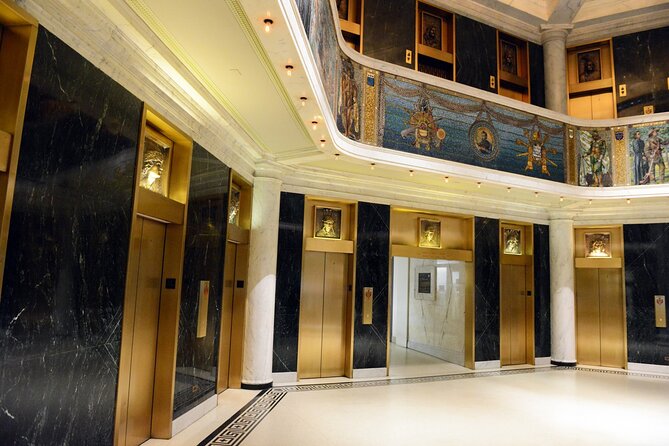
Chicago keeps its best rooms behind ordinary doors.
This two-hour walk through the Loop reveals grand lobbies, mosaics, domes, and historic interiors that are easy to miss from the sidewalk. I especially like the focus on little-seen interiors and the way the guides connect architecture with Gilded Age fortunes, commerce, and engineering. At $35, it offers strong value for anyone who wants more than a quick look at Chicago’s famous towers. The main drawback is that the route involves outdoor walking in changing weather, and the Rookery is closed on Sundays.
I also like the manageable length. You cover a lot of ground without giving up a whole day, and much of the program takes place indoors. Guides such as Ethan, Grant, Ty, Matt, and Matthew have earned especially warm praise for their energy, humor, organization, and ability to keep a group together.
In This Review
- Five things to know before you go
- Why Chicago’s interiors are worth your time
- Starting at Union Station
- The Financial Canyon around La Salle Street
- The Rookery’s light court and Wright connection
- The Field Building and Chicago’s Art Deco turn
- Marquette Building mosaics and Chicago School design
- Palmer House and the theater of hotel luxury
- The Cultural Center or Monadnock Building
- Marshall Field’s Tiffany dome and the final stop
- The guides make the difference
- Practical advice for a comfortable walk
- Who will appreciate this tour most
- Should you book Chicago’s Secret Interiors tour?
- FAQ
- How long does the Chicago’s Secret Interiors Architectural Walking Tour last?
- Where does the tour begin?
- Where does the tour end?
- Is the Rookery included on Sundays?
- What is included in the price?
- What happens if bad weather cancels the tour?
Five things to know before you go
- The Rookery is a major prize: Burnham and Root’s 1888 building includes a light court and a lobby later redesigned by Frank Lloyd Wright.
- The route ends at Macy’s: You finish at the former Marshall Field and Company Building, known for its Tiffany glass dome and walnut-paneled Tea Room.
- You see Chicago from the inside out: The walk links grand interiors with the architects, financiers, retailers, and engineers who shaped the Loop.
- Union Station is part of the story: Its Beaux-Arts design, Great Hall, and 1925 completion show how rail travel helped define Chicago.
- The group is intended to be small: The stated maximum is 15 people, though one account describes a much larger gathering, so group size may vary.
- Weather affects the day: The experience requires good weather, but you can receive a full refund or choose another date if poor conditions cancel it.
Why Chicago’s interiors are worth your time
Most first-time visitors see Chicago from the river or from the street. Those views are worthwhile, but they leave out the city’s most surprising feature: the quality of its public rooms.
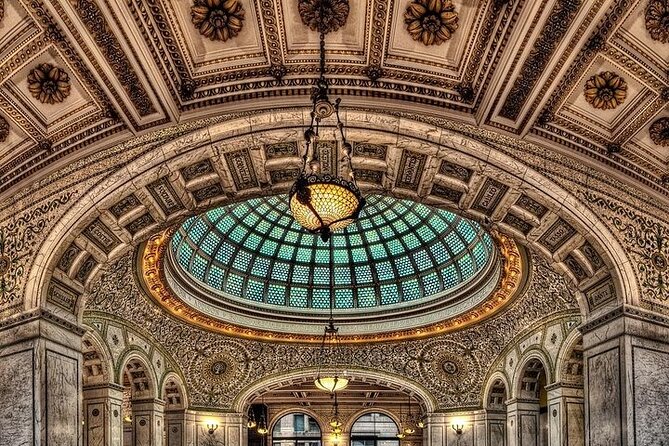
A plain doorway can lead to a lobby lined with mosaics. A department store can contain a glass dome worthy of a cathedral. An office building can reveal the ambition of the men who rebuilt Chicago after the Great Fire and then raced to push commercial architecture upward.
That is the appeal of this walk. It is not simply a parade of tall buildings. Your guide explains why these structures look the way they do, who paid for them, and how architects solved practical problems involving light, weight, height, and crowded city blocks.
The tour costs $35 and lasts about two hours. That is a fair price for a guided introduction to central Chicago, especially since many of the interiors would be easy to overlook if you were exploring alone. The guide adds the value. Without one, you may notice a handsome ceiling or a grand staircase, but you are less likely to understand why it matters.
The route also works well as a partner to a river architecture cruise. One visitor specifically found that the walk did not repeat the boat tour. The river shows you the city’s exterior walls and skyline. This walk takes you through the doors.
More Walking Tours in Chicago
- Chicago: Gangsters and Ghosts Walking Tour
★ 5.0 · 7,155 reviews - Chicago Favorites Ultimate Food and Walking Tour
★ 5.0 · 1,962 reviews - Chicago: Gangsters and Ghosts Guided Walking Tour
★ 4.7 · 1,697 reviews
Starting at Union Station
The meeting point is Chicago Union Station at 225 South Canal Street. This is a sensible place to begin because Union Station introduces the scale and confidence of early twentieth-century Chicago before the walk moves into the financial district.
The station was designed by Daniel Burnham and completed in 1925. Its Beaux-Arts exterior gives way to the famous Great Hall, where a large skylight and generous proportions create the feeling of a civic palace rather than a place where people simply catch trains.
You can expect about ten minutes here. That is enough to appreciate the major features and hear why the station mattered to Chicago’s growth. It also gives you a useful lesson for the rest of the walk: in Chicago, transportation buildings, office towers, hotels, and stores were all designed to make a public impression.
Union Station remains an active transportation hub, so the atmosphere can be busy. Keep close to your guide and be ready for some background noise. The payoff is an immediate sense of the city’s ambition.
The Financial Canyon around La Salle Street
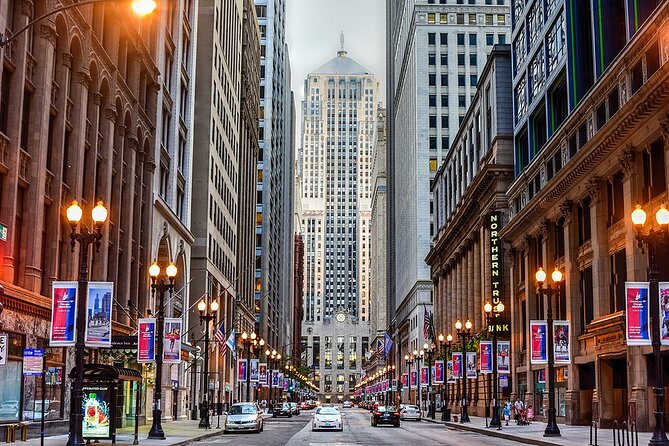
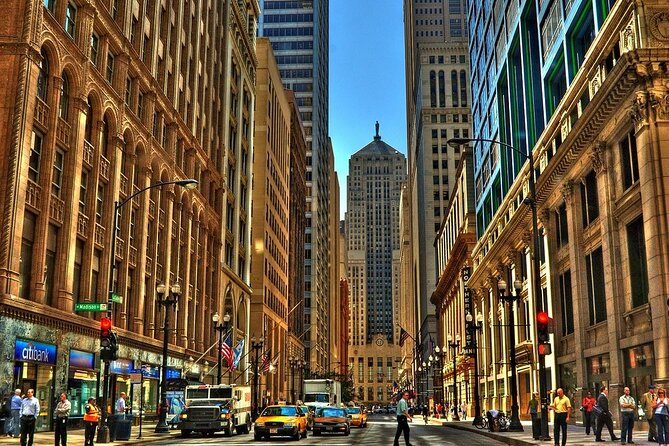
The next portion moves into the Loop and the area around La Salle Street. The phrase Financial Canyon fits the setting. Tall buildings line the streets closely, creating long corridors of stone, steel, and glass.
Your guide points out the Chicago Board of Trade and Willis Tower while explaining the economic forces behind the district. The Board of Trade represents Chicago’s role in finance and commodity trading. Willis Tower represents a later chapter in the city’s push toward greater height.
The key here is comparison. You are not just looking at old buildings beside new ones. You are seeing different answers to the same urban problem: how to fit offices, workers, light, and commerce into a limited area.
The exterior stops are brief, around ten minutes each, but they help you read the city. Look up, then look down at the entrances and decorative details. A guide can point out features you would probably pass without a second glance.
This is also where weather matters most. You move between buildings, so rain, wind, or cold can make the walk less pleasant. Still, several indoor stops break up the outdoor sections. A cold day need not ruin the experience, but you should dress for Chicago rather than for the forecasted high temperature alone.
The Rookery’s light court and Wright connection
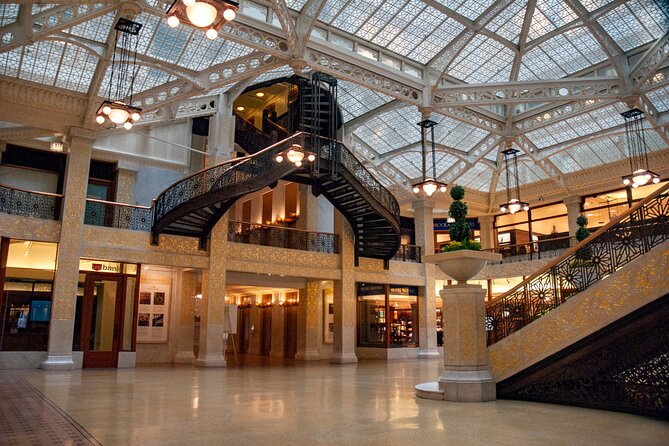
The Rookery is likely to be the most memorable stop for architecture fans. Burnham and Root designed the building in 1888, and Frank Lloyd Wright later reworked its lobby.
The building combines Romanesque and Moorish influences. Its light court, ironwork, and oriel staircase show how architects used decoration and structure together. The light court is especially important because it helped bring daylight into a deep commercial building, a practical need in an era before modern electric lighting was common.
The lobby’s connection to Wright adds another layer. You can see how a later designer interpreted an earlier building rather than wiping away its original character. This makes the Rookery useful for understanding Chicago architecture as an evolving conversation.
The visit is listed as about ten minutes, so do not expect a long, slow inspection of every detail. Use those minutes well. Look toward the upper levels, study the metalwork, and ask your guide about the changes to the lobby.
There is one firm scheduling issue: the Rookery is closed on Sundays. On that day, it will not be included in the route. If this building is the main reason you want to book, choose another day.
More walking tours:
- Chicago in a Day: Food, History & Architecture Walking Tour
★ 5.0 · 1,153 reviews - Chicago’s Chinatown Food and Walking Tour
★ 5.0 · 600 reviews - Chicago: Secret Interiors Architecture Walking Tour
★ 4.9 · 498 reviews - Chicago Gangster and Food Walking Tour
★ 5.0 · 471 reviews
The Field Building and Chicago’s Art Deco turn
The Field Building provides a change of mood. It is associated with Art Deco design, a style known for strong geometry, polished surfaces, and a sense of modern luxury.
After seeing nineteenth-century commercial architecture at the Rookery and Marquette, the Field Building helps you see how Chicago’s visual language changed. The city did not abandon grandeur. It recast grandeur in a sharper, more streamlined form.
The visit is brief, but it gives the tour useful variety. You are not walking through nine versions of the same grand lobby. Each stop marks a different period in Chicago’s growth and changing taste.
If you are mainly interested in exterior skyscrapers, this section may feel less dramatic than the Board of Trade or Willis Tower. If you like design details, it is an important link between the older Loop and the modern city.
Marquette Building mosaics and Chicago School design
The Marquette Building is one of the tour’s strongest stops for anyone who enjoys art as much as architecture.
It is celebrated for its early use of the Chicago window, a design that placed a large fixed pane between two smaller movable windows. This arrangement improved daylight and ventilation while giving the building a distinctive appearance.
Inside, the lobby contains ornate mosaics connected with Jacques Marquette’s exploration of Illinois. They turn a passageway into a visual lesson about place, exploration, and identity.
The terra cotta exterior is another reason to pay attention. Terra cotta allowed architects to apply detailed decoration without relying entirely on heavy stone. Your guide can help you connect that material choice with the technical changes that allowed Chicago’s commercial buildings to grow taller.
Ten minutes may sound short, but the stop fits the rhythm of the walk. You get a focused explanation, time to look around, and then move on before your attention fades.
Palmer House and the theater of hotel luxury
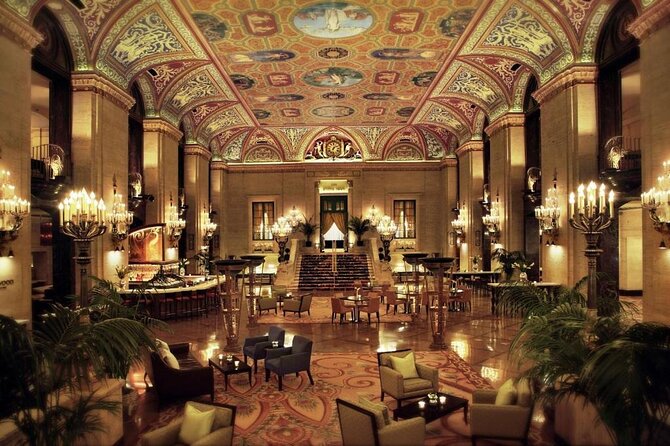
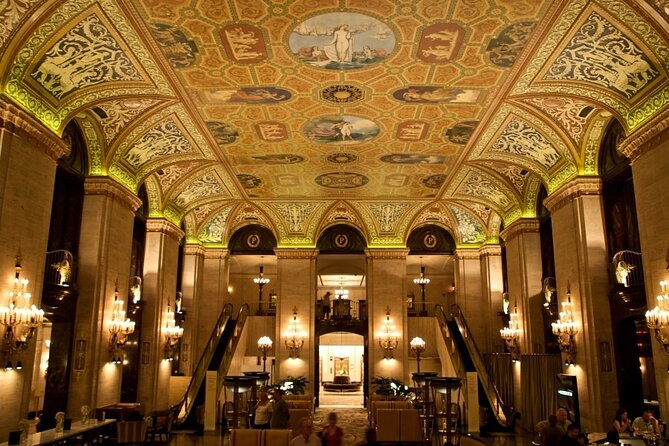
The Palmer House gives you the grand hotel version of Chicago. Rebuilt after the Great Chicago Fire of 1871, it reflects the city’s determination to return bigger and more impressive than before.
Inside, the hotel is known for an opulent lobby, mosaic floors, a frescoed ceiling, and bronze peacock doors. These details were designed to impress guests the moment they entered. The hotel also connects architecture with celebrity and power, having hosted stars and dignitaries over the years.
I find this stop valuable because it explains how architecture worked socially. A hotel was not only a place to sleep. It was a stage where wealthy visitors, business leaders, and public figures could see and be seen.
The Palmer House can feel more decorative than structural, especially if your main interest is engineering. That is part of its usefulness, though. The tour is showing you how Chicago’s buildings expressed status, taste, and ambition, not only how they held up under weight.
The Cultural Center or Monadnock Building
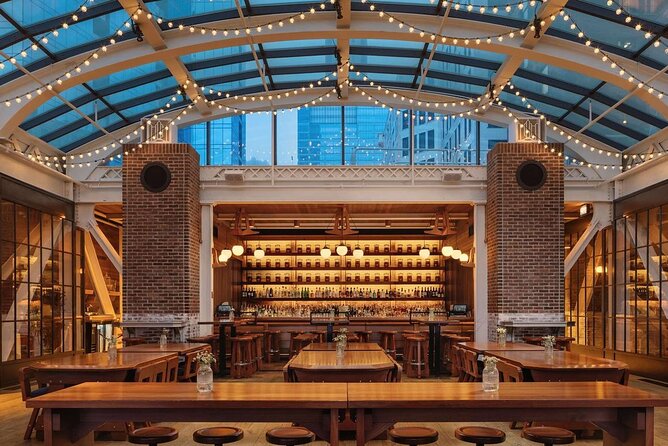
At this point, the route includes either the Chicago Cultural Center or the Monadnock Building. The exact choice matters because these two stops offer different architectural experiences.
The Chicago Cultural Center is known for its architectural beauty and cultural role. It gives you another chance to see a public interior designed to make an impression, with details that reward looking upward and around rather than simply moving through.
The Monadnock Building represents late nineteenth-century commercial architecture. It is associated with the older commercial style that shaped the Loop before the glass-and-steel office tower became standard.
Because the itinerary allows one or the other, you should not assume you will see both on a single outing. If one building is a personal priority, ask about the day’s route when you meet your guide.
This stop also helps break up the architectural eras. You have already seen Art Deco, Beaux-Arts, Romanesque, Moorish, and Chicago School elements. The Cultural Center or Monadnock adds another point of comparison.
Marshall Field’s Tiffany dome and the final stop
The walk ends at the former Marshall Field and Company Building at 111 North State Street. Today it houses Macy’s, but its earlier identity remains central to the building’s character.
The interior’s Tiffany glass mosaic dome is the headline feature. It shows how a department store could use fine art and monumental decoration to persuade shoppers that buying goods was a special event.
The walnut-paneled Tea Room adds a more intimate note. It reflects the elegance of early twentieth-century department stores, when shopping could include dining, social visits, and an afternoon out.
This is a fitting final stop because it brings together commerce and architecture. The Loop was built not only for banks and offices, but also for grand retail institutions. Marshall Field’s helped make State Street a major shopping destination, and the building still functions as a busy commercial center.
The tour ends here rather than returning to Union Station. Plan your next move before you start. State Street provides easy access to more of the Loop, but you will need to arrange your own way back to your hotel or starting point.
The guides make the difference
The strongest part of this experience is the human element. Ethan is repeatedly praised for enthusiasm, clarity, humor, and strong command of Chicago architecture and history. He has also handled difficult weather while keeping the group engaged.
Grant is described as warm, organized, and attentive to pace. That matters on a walking tour with frequent street crossings and indoor stops. Ty is praised for being accommodating, funny, and full of useful detail. Matt and Matthew are also noted for clear explanations and a good balance of professionalism and humor.
Guide quality can vary on any scheduled tour, but this experience has a strong record in that area. The overall rating is 4.9 from 635 reviews, with 98 percent recommending it. There is one serious service complaint about a guide failing to arrive and not responding to calls, so I would keep your booking confirmation and contact details handy on the day.
The stated group limit is 15 people. One account describes a group of about 40, however, so actual attendance may not always match the advertised maximum. A smaller group is better for hearing explanations inside busy buildings. If your group is large, stay near the guide.
Practical advice for a comfortable walk
Wear comfortable shoes. The route covers central Chicago on foot, with repeated movement between outdoor streets and indoor buildings.
Bring layers and prepare for rain, wind, or cold. The tour requires good weather and may be canceled if conditions are poor. In that case, you are offered another date or a full refund.
The start is near public transportation, and most people can participate. Service animals are allowed. The experience uses a mobile ticket, so keep your confirmation easy to access on your phone.
The itinerary lists roughly ten minutes at each stop, but the total experience is about two hours. One account reports a tour lasting around an hour and a half, including a fifteen-minute break. Treat the timing as approximate rather than rigid.
Book at least 24 hours before the start if you want flexibility. Cancellation at least 24 hours in advance brings a full refund. Within 24 hours, you cannot receive a refund or make changes, except when the operator cancels for poor weather.
Who will appreciate this tour most
I would choose this walk if you enjoy architecture, city planning, design, or stories about the people who built Chicago. It also suits repeat visitors who have already taken a river cruise and want a different view of the Loop.
It is a good option for a half-day plan. You can follow it with lunch, shopping around State Street, or more independent sightseeing near the end point.
You may want something else if you dislike walking, need a slow pace, or want extended time inside each building. The stops are short, and some interiors may be unavailable on a particular day. Sunday visitors should be especially careful if the Rookery is at the top of their list.
Should you book Chicago’s Secret Interiors tour?
Yes, if you want a compact, affordable introduction to Chicago’s architectural interiors. The $35 price is reasonable because the guide gives meaning to buildings you could otherwise walk past, and the route includes several major landmarks without taking over your day.
I would book it on a weekday or Saturday if seeing the Rookery matters to you. Arrive ready for outdoor walking, keep an eye on the group, and expect the guide to be the key variable. With a strong guide such as Ethan, Grant, Ty, Matt, or Matthew, this can be one of the most rewarding ways to see Chicago’s Loop from the inside.
FAQ
How long does the Chicago’s Secret Interiors Architectural Walking Tour last?
The advertised duration is approximately two hours. Actual timing can vary, and one account describes a tour lasting about an hour and a half with a fifteen-minute break.
Where does the tour begin?
The meeting point is Chicago Union Station at 225 S Canal Street, Chicago, Illinois 60606.
Where does the tour end?
The tour ends at the Marshall Field and Company Building, now Macy’s, at 111 N State Street, Chicago, Illinois 60602.
Is the Rookery included on Sundays?
No. The Rookery is closed on Sundays, so it is not included in the route on that day.
What is included in the price?
The $35 price includes an expert tour guide. A mobile ticket is provided for the experience.
What happens if bad weather cancels the tour?
The experience requires good weather. If it is canceled because of poor conditions, you will be offered another date or a full refund.
Recently added around Chicago
- Chicago Pizza Tour★ 5.0 · 454 reviews
- Chicago: Architecture Center Cruise on Chicago’s First Lady★ 4.7 · 456 reviews
- Chicago: Architecture Boat Tour with Drinks★ 4.7 · 466 reviews
- Chicago Gangster and Food Walking Tour★ 5.0 · 471 reviews
- Chicago Night Crimes Tour by Bus★ 5.0 · 478 reviews
- Flyover in Chicago★ 5.0 · 486 reviews
- Field Museum of Natural History Admission Tickets★ 4.5 · 489 reviews
- Chicago: Secret Interiors Architecture Walking Tour★ 4.9 · 498 reviews
Walking Tours, compared.

History and Hauntings of Salem Guided Walking Tour
Read our review →
New Orleans Premier Ghost, Voodoo and Vampire Walking Tour
Read our review →

Freedom Trail History Small Group Walking Tour
Read our review →
Historic Charleston Guided Sightseeing Walking Tour
Read our review →
New Orleans Food Walking Tour of the French Quarter with Small-Group Option
Read our review →
St. Louis Cemetery No. 1 Official Walking Tour
Read our review →Browse the lists this tour appears in