
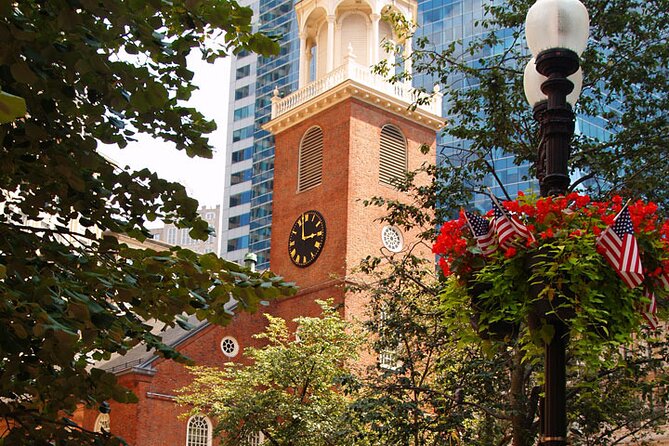
Reviewed · FREEDOM TRAIL TOURS
Entire Freedom Trail Walking Tour: Includes Bunker Hill and USS Constitution
Boston tells its story one stone at a time. This four-hour walk follows the entire 2.8-mile Freedom Trail, from Beacon Hill to Charlestown, connecting famous sites with the people and arguments behind the American Revolution. I like the full route because you do not have to choose between downtown landmarks, Bunker Hill, and Old Ironsides. I also like the guide-led storytelling, especially Mark’s cause-and-effect approach and his attention to women and lesser-known figures.
The main drawback is simple: this is a serious walking tour, not a quick sampler. You cover roughly 10,000 steps, cross into Charlestown, and spend much of the day on your feet. Interiors are not included, so you will need extra time and admission money if you want to go inside the historic buildings.
In This Review
- Key things to know before you book
- Why the full Freedom Trail route works so well
- From the State House to Granary Burying Ground
- King’s Chapel and the early fight over religious power
- Old City Hall, the Old South Meeting House, and the Boston Tea Party
- The Old State House and a more complicated Boston Massacre
- Faneuil Hall and the Blackstone Block
- Paul Revere’s house and the road to Lexington
- Copp’s Hill, Bunker Hill, and the cost of battle
- Finishing with USS Constitution, Old Ironsides
- Mark’s style and the value of a small group
- Is $79 a fair price?
- Practical advice for making the walk comfortable
- Who should book this Freedom Trail tour?
- FAQ
- How long is the Entire Freedom Trail Walking Tour?
- Where does the tour begin?
- Where does the tour end?
- Are admission fees included?
- Is the tour suitable for children?
- What happens if the weather is poor?
Key things to know before you book
- The tour covers the whole 2.8-mile trail: You begin at Park Street and finish at the USS Constitution in Charlestown.
- Bunker Hill and Old Ironsides are included: Many shorter walks end downtown, but this one continues across the harbor area to two major Revolutionary-era sights.
- Mark’s teaching style is the main attraction: His years of study, maps, humor, and clear explanations help connect separate events into one understandable story.
- The pace is manageable but the distance is real: The route is mostly flat, yet four hours of walking calls for comfortable shoes and a moderate fitness level.
- The group is limited to 16 people: That is small enough for questions and easier movement through crowded streets.
- Admission to interiors is extra: You see and discuss the buildings, but paid entry is not part of the $79 price.
Why the full Freedom Trail route works so well

The Freedom Trail can look like a row of red-brick landmarks if you walk it without context. One church, burying ground, or meeting hall follows another, and it is easy to miss how the events fit together.
A good guide turns the route into a chain of pressure, protest, violence, and war. At the start, you meet the colonial government and religious institutions. Then you follow the arguments over taxation and rights through the Boston Massacre and Boston Tea Party. Near the end, the story moves toward military action at Lexington, Concord, and Breed’s Hill.
That full arc is the value of this tour. You are not simply collecting photographs. You are hearing why each location mattered and how one dispute helped produce the next.
The walk starts at 10 a.m. near Park Street, a useful place to begin because Boston Common and Beacon Hill are close by. It ends at the USS Constitution Museum in the Charlestown Navy Yard area. Plan your afternoon from that endpoint rather than assuming you will return to the starting point quickly.
More Walking Tours in Boston
- Boston: Freedom Trail History Small Group Walking Tour
★ 5.0 · 6,450 reviews - Cambridge: Harvard University Student-Guided Walking Tour
★ 4.6 · 3,931 reviews - Harvard University Campus Guided Walking Tour
★ 4.5 · 3,632 reviews
From the State House to Granary Burying Ground
The first stop is the Massachusetts State House, where you see the current seat of state government. The building was designed by Charles Bulfinch, an important early American architect, and the stop also points out the three buildings that have served as Massachusetts government seats.
This opening gives you a useful civic starting point. The Revolution was not only fought by soldiers. It grew from arguments over who had the right to make laws and collect taxes. You get that political setting before moving into the older streets.
At Park Street Church, the guide explains why the building was once the tallest in the country and why it became known as Brimstone Corner. Its fiery sermons connected it to the abolition movement, while the church’s cellar gives the stop an odd and memorable historical detail.
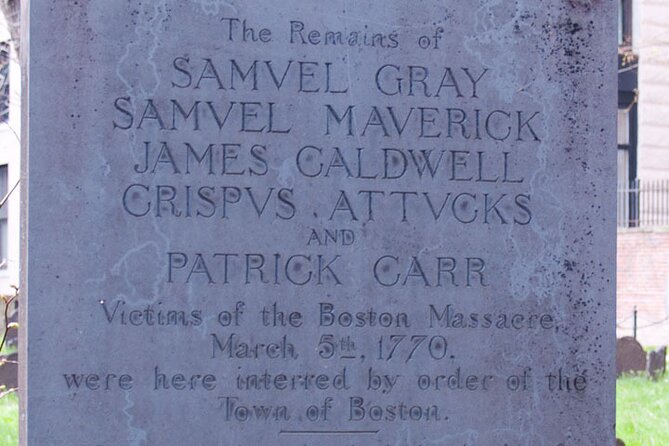
You then enter Granary Burying Ground, one of the most important graveyards on the route. Samuel Adams, Paul Revere, John Hancock, and victims of the Boston Massacre are buried here. The useful part is not simply seeing the names on gravestones. Mark introduces the figures and explains the roles they played, giving you faces and personalities to attach to the larger story.
This is one of the tour’s strongest teaching moments. You are standing among the people who shaped events, not reading a list of names in a museum panel. The stop lasts about 10 minutes, so expect an introduction rather than a long period for private wandering.
King’s Chapel and the early fight over religious power
King’s Chapel looks like a church stop, but the story reaches back to the 1680s. The building represents the conflict between Puritan Boston and the English crown, which took land for an unwanted Anglican church.
That detail helps explain why religion and politics were so closely tied in colonial Boston. The dispute was not just about worship. It was also about royal authority, local control, and who had the power to change the city.
The church dates to 1749, and interior admission is not included. You can listen to the explanation and see the building from the route, then decide if you want to return later for a paid visit. Since the whole tour has a packed schedule, do not expect to explore every interior during the walk.
Old City Hall, the Old South Meeting House, and the Boston Tea Party
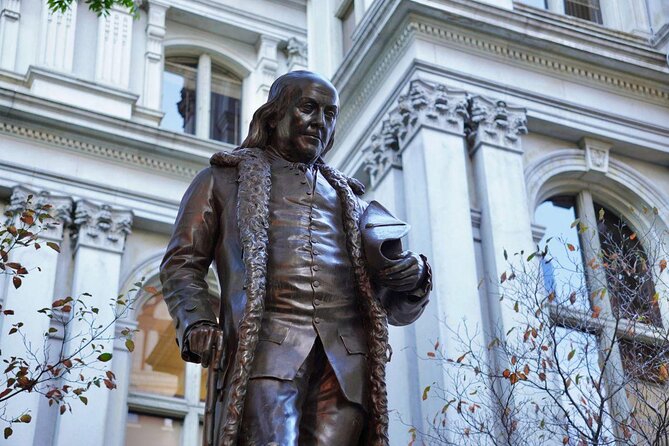
At Old City Hall, the route shifts toward Boston’s civic memory. You see a statue of Benjamin Franklin and a marker for the oldest school still operating in the colony. These are brief stops, but they show how Boston’s public life developed around education, government, and open debate.
The Old South Meeting House is more central to the Revolution story. Colonial meeting halls served as places where preachers, politicians, and ordinary residents gathered to hear arguments. Samuel Adams used this Puritan meeting house to rally opposition before the Boston Tea Party.
I like this stop because it puts the Tea Party in a wider setting. The famous act of throwing tea into the harbor did not appear from nowhere. It followed public meetings, political organizing, and growing anger over taxation and colonial rights.
Admission to the interior is not included, so the tour focuses on its role and exterior. If you want to see the meeting room itself, plan a separate visit. The tour’s aim is to keep the story moving, and the next stop adds an important legal and military dimension.
More Freedom Trail walks:
- Boston Freedom Trail Walking Tour with Costumed Guide
★ 4.5 · 2,531 reviews - Boston Food & History: Pizza, North End & Freedom Trail
★ 5.0 · 1,772 reviews - Boston’s Freedom Trail: A Revolutionary Walking Tour
★ 4.9 · 1,748 reviews - Boston: Freedom Trail History Small Group Walking Tour
★ 4.9 · 1,590 reviews
The Old State House and a more complicated Boston Massacre
The Old State House was once the center of British government in Boston. It was also the site of a major 1761 court battle that exposed the conflict over colonial rights.
The building is best understood as a place where law and political power met. The story then moves to the Boston Massacre in 1770, when British soldiers killed colonists in the street. The guide does not simply repeat the familiar Patriot version. He asks you to consider how the confrontation developed and whether the event happened in the simple way later propaganda suggested.
That approach is one of the tour’s best features. You get the drama, but you also get a reminder that history is often argued over by people with strong political goals. The Old State House is an ideal place to discuss that problem because the building itself was part of the government the colonists distrusted.
The stop is about 10 minutes. Interior admission is extra, and the tour does not promise time for an extended museum visit.
Faneuil Hall and the Blackstone Block
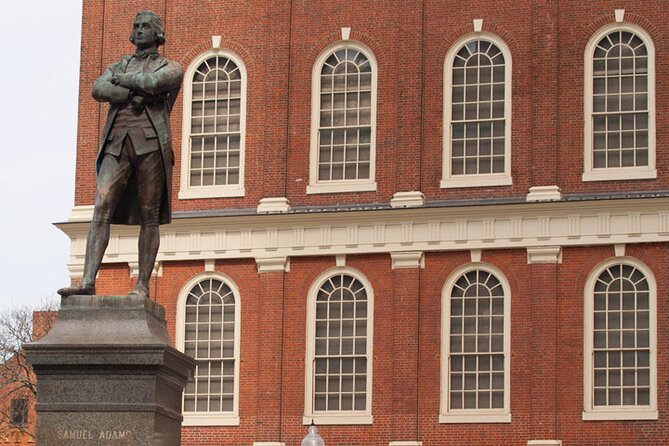
Faneuil Hall carries the story into Boston’s tradition of public speech. Samuel Adams spoke here about taxation and representation, while Frederick Douglass later used the hall to speak against slavery. The building therefore connects the Revolution with a much longer American struggle over political voice and equal rights.
That broader connection keeps the tour from becoming a narrow parade of Revolutionary War dates. You hear how Boston’s meeting places continued to matter after independence.
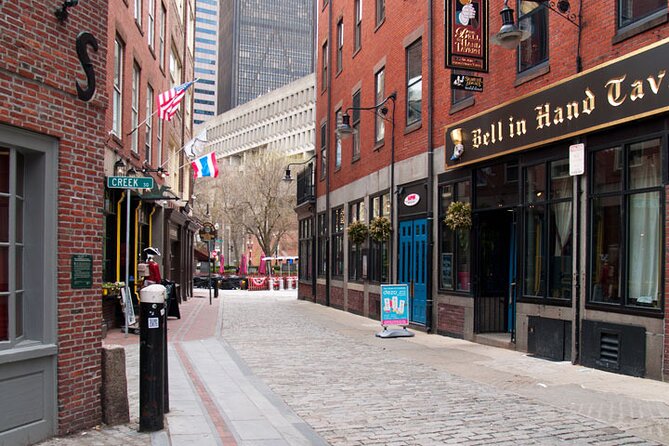
The Blackstone Block offers some of the route’s more unusual stops. You learn about the Massachusetts Spy newspaper, a bar known as the Headquarters of the Revolution, and the home of Ebenezer Hancock, John Hancock’s brother. French money sent to support the Revolution was stored in Ebenezer’s house.
These details are easy to miss if you follow only the official red line. Mark’s material adds context beyond the most photographed landmarks, and several people specifically appreciated those extra locations. This part is also a good example of the tour’s style: less theatrical reenactment, more direct explanation supported by maps, stories, and connections.
Paul Revere’s house and the road to Lexington
The Paul Revere House is one of Boston’s oldest surviving homes. Revere bought the 1680 post-medieval house in 1770 and raised a large family there, fathering 16 children with two wives.
The building gives you a more personal view of Revere than the midnight ride alone. He was not just a rider in a famous story. He was a husband, father, craftsman, and participant in Boston’s political network.
The stop is brief, about five minutes, and interior admission is not included. That matters because the house is small and has limited space. You will learn why it matters, but you should not expect a long private visit during the group walk.
At Old North Church, the guide explains the signal that warned Patriots across the water in Charlestown that British regulars were moving toward Lexington and Concord. This is the point where the political crisis becomes an armed one.
The church’s role is memorable because the signal was practical communication, not legend floating free from geography. The route helps you understand the distance and waterways involved, which makes the warning system easier to picture.
Copp’s Hill, Bunker Hill, and the cost of battle

Copp’s Hill Burying Ground helps you read the ground before reaching Bunker Hill. From here, the guide explains the geography of the battle and points out a grave marker with its own story.
The stop is short, but it prepares you for the military history ahead. Boston’s streets and harbor are not just scenery. They shaped how troops moved and how people understood the fighting.
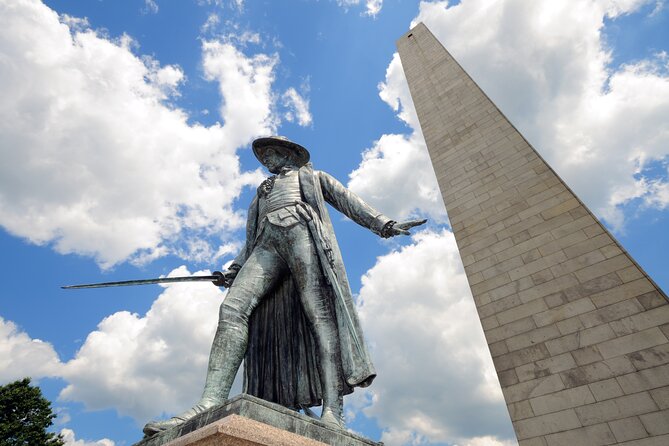
At Bunker Hill Monument, you learn that the battle was actually fought on Breed’s Hill. The Patriots lost the position, but British casualties were roughly three times higher. That fact explains why the battle could be remembered as both a military loss and a political victory for the American cause.
The monument is free to visit from the listed tour information, but the experience here is still mainly a guided outdoor explanation. The tour does not promise a climb or an extended monument interior visit.
This part adds physical effort at the right moment in the story. You have walked from the colonial center to the place where arguments became open combat. It is also where the four-hour length becomes most noticeable. Wear shoes that can handle city pavement and do not treat the walk as a casual stroll.
Finishing with USS Constitution, Old Ironsides
The final stop is the USS Constitution, the oldest commissioned warship in the world. Known as Old Ironsides, it served the United States Navy in American and foreign waters and remains one of the country’s most important surviving naval treasures.
Ending here gives the tour a strong final image. The Freedom Trail begins with government, religion, and public protest, then ends with a ship that represents the new nation’s military strength.
The tour concludes at the USS Constitution Museum, Building 22, in the Charlestown Navy Yard area. The listed stop is free, while admission to interiors generally is not part of the tour package, so confirm what you want to see before planning the rest of your day.
The endpoint is worth noting for practical reasons. You do not finish where you began, and the tour does not include a return transfer. Nearby public transportation makes the area reachable, but you should still allow time to orient yourself after the guide says goodbye.
Mark’s style and the value of a small group
The most praised part of this experience is the guide. Mark is described as friendly, funny, down to earth, and exceptionally well prepared. His strength is not just recalling facts. He connects people, decisions, and consequences so the Revolution feels like a developing argument rather than a schoolbook list.
He uses maps and original material to support the narration. You can expect plenty of questions and explanations, not a costumed performance. He also makes room for women’s contributions and for figures who often disappear from basic American history lessons.
That teaching style suits adults who want more detail and families with teenagers. It can also work for older children who already enjoy history, but the guide himself cautions that children under 12 should be genuinely interested to get the most from four hours.
The maximum group size is 16. That helps in a busy city, where a large crowd would be hard to keep together near narrow sidewalks and popular landmarks. It also gives you a better chance to ask questions and hear the guide clearly.
The tour receives a 5.0 rating from 732 reviews, with 100 percent recommending it. Those figures point to unusually consistent satisfaction, especially with the guide’s presentation, pace, historical depth, and personal attention. I would still read the physical demands honestly: the walk is manageable for many people, but it is long.
Is $79 a fair price?
At $79 per person, the tour is not the cheapest way to follow the Freedom Trail. You can walk the public route yourself for very little money. The price pays for the four-hour narration, the full route, the bridge to Charlestown, and the guide’s ability to explain why each stop matters.
The included guide gratuity also makes the price clearer. Mark does not expect or accept tips, so you do not need to calculate an extra amount at the end.
The value is strongest if you are visiting Boston for the first time, care about the American Revolution, or want one organized experience that covers the entire trail. It is weaker if you prefer to linger inside every church and museum, since those admissions are separate and the group schedule keeps moving.
I also think the price works well for families with older children and teenagers. A clear narrative can hold attention better than a self-guided walk, and the small group helps prevent the experience from feeling like a crowded procession.
Book ahead if your dates are fixed. This experience is booked an average of 55 days in advance, which suggests that popular dates can fill well before arrival.
Practical advice for making the walk comfortable
Start with comfortable shoes. That is the most repeated practical lesson, and it matters more than any packing trick. You will walk the full route, cross into Charlestown, and remain outdoors for about four hours.
The tour requires moderate physical fitness. Most of the route is described as an easy, slow-paced walk on mostly flat ground, and seniors have found the pace manageable. Still, the total distance is substantial, and you should be ready to walk a lot.
Bring water, especially in warm weather. Mark has provided extra water on some tours, but you should not depend on that. Check the forecast because the experience requires good weather and can be moved or canceled if conditions are poor.
The tour is offered in English and uses mobile tickets. Service animals are allowed, and the meeting point is close to public transportation. Paid entry into the interiors is not included, so set aside extra time and money if you want to explore the State House, King’s Chapel, Old South Meeting House, Old State House, Paul Revere House, or Old North Church from inside.
Free cancellation is available up to 24 hours before the 10 a.m. start time for a full refund. Changes or cancellations inside that window are not accepted for a refund.
Who should book this Freedom Trail tour?
I would book it if you want the complete Boston story in one morning and prefer a guide who teaches rather than performs. History fans, first-time visitors, couples, and families with interested teenagers are the best match.
I would also choose it if you want Bunker Hill and USS Constitution included. Many people walk the downtown section and stop before Charlestown, but this route gives you the military and naval ending that completes the story.
I would skip it if four hours on foot sounds tiring, if you want lots of museum time, or if your children are too young to follow a detailed historical discussion. For everyone else, the combination of full coverage, a small group, and Mark’s clear storytelling makes $79 a reasonable investment in understanding Boston.
FAQ
How long is the Entire Freedom Trail Walking Tour?
The tour lasts approximately four hours and follows about 2.8 miles, or 4 kilometers, from Park Street to the USS Constitution in Charlestown.
Where does the tour begin?
It begins at 10 a.m. near Beacon Street and Park Street in Boston, Massachusetts.
Where does the tour end?
The tour ends at the USS Constitution Museum, Building 22, in the Charlestown Navy Yard area.
Are admission fees included?
Admission to the interiors is not included. The tour includes guided stops at the historic sites, while any interior visits require separate admission when applicable.
Is the tour suitable for children?
It can be a good educational activity for families with teenagers. Because the walk lasts about four hours, younger children should have a strong interest in history and be comfortable walking the full route.
What happens if the weather is poor?
The experience requires good weather. If it is canceled because of poor conditions, you will be offered another date or a full refund.
More Walking Tours
- The Full Revolutionary Story Epic Small Group Boston Walking Tour
★ 5.0 · 2,356 reviews - Boston’s Freedom Trail: A Revolutionary Walking Tour
★ 5.0 · 1,343 reviews - Boston’s North End Food Tour: Italian Flavors & Heritage Walk
★ 5.0 · 1,322 reviews - Freedom Trail Walking Tour 250
★ 4.5 · 1,118 reviews
Recently added around Boston
- Boston’s Politically Incorrect North End Food Tour★ 5.0 · 453 reviews
- Boston’s North End Food and History Walking Tour★ 5.0 · 459 reviews
- Downtown Freedom Trail, Beacon Hill & Back Bay Walking Tour★ 4.5 · 473 reviews
- Cambridge, Massachusetts: MIT and Harvard Walking Tour★ 4.7 · 486 reviews
- Narrated Sunset Cruise of Boston Harbor★ 4.0 · 532 reviews
- Sightseeing Day Sail around Boston Harbor★ 5.0 · 541 reviews
- Boston: Harbor Sunset Yacht Cruise★ 4.6 · 570 reviews
- Boston: Martha’s Vineyard Day Trip with Optional Island Tour★ 4.6 · 573 reviews
Freedom Trail Tours, compared.

Freedom Trail History Small Group Walking Tour
Read our review →
Boston Freedom Trail Walking Tour with Costumed Guide
Read our review →
Boston Food & History: Pizza, North End & Freedom Trail
Read our review →
Boston’s Freedom Trail: A Revolutionary Walking Tour
Read our review →Freedom Trail History Small Group Walking Tour
Read our review →Boston’s Freedom Trail: A Revolutionary Walking Tour
Read our review →

Boston Freedom Trail History Pub Crawl Small-Group Tour
Read our review →Browse the lists this tour appears in